

3I Atlas comet updates: Where is it now, and what scientists are saying

The mysterious Manhattan-sized comet 3I/ATLAS | ChicagoNOW
New updates on the comet 3I/ATLAS. Harvard astrophysicist Avi Loeb has been closely tracking this object and exploring the possibility that it could even be alien technology.
The 3I/ATLAS comet is continuing its journey through our solar system, making its way around the sun and back again.
Here is the latest on where the comet is, and what scientists and physicists are saying about it:
What is the 3I Atlas comet?
Big picture view:
The comet known as 3I/ATLAS was discovered this summer after it entered from another star system. It got its name because it is the third interstellar object known to have visited our solar system (3I), and because ATLAS was the telescope in Chile that discovered the object, according to Harvard astrophysicist Avi Loeb.
Timeline:
The comet was discovered on July 1, 2025, out near Jupiter. Scientists say it was discovered early during its journey through our solar system, giving experts ample time to watch and study the icy snowball.
Earlier in October, the comet approached Mars and came within 18 million miles of the red planet.
Right now, it’s making its closest approach to the sun, which NASA predicted would happen in late October.
Throughout November, the European Space Agency’s Juice spacecraft, which is headed to Jupiter and its icy moons, will keep an eye on the comet.
And then in December, it will swing back and be at its closest to Earth — though still about 167 million miles away.
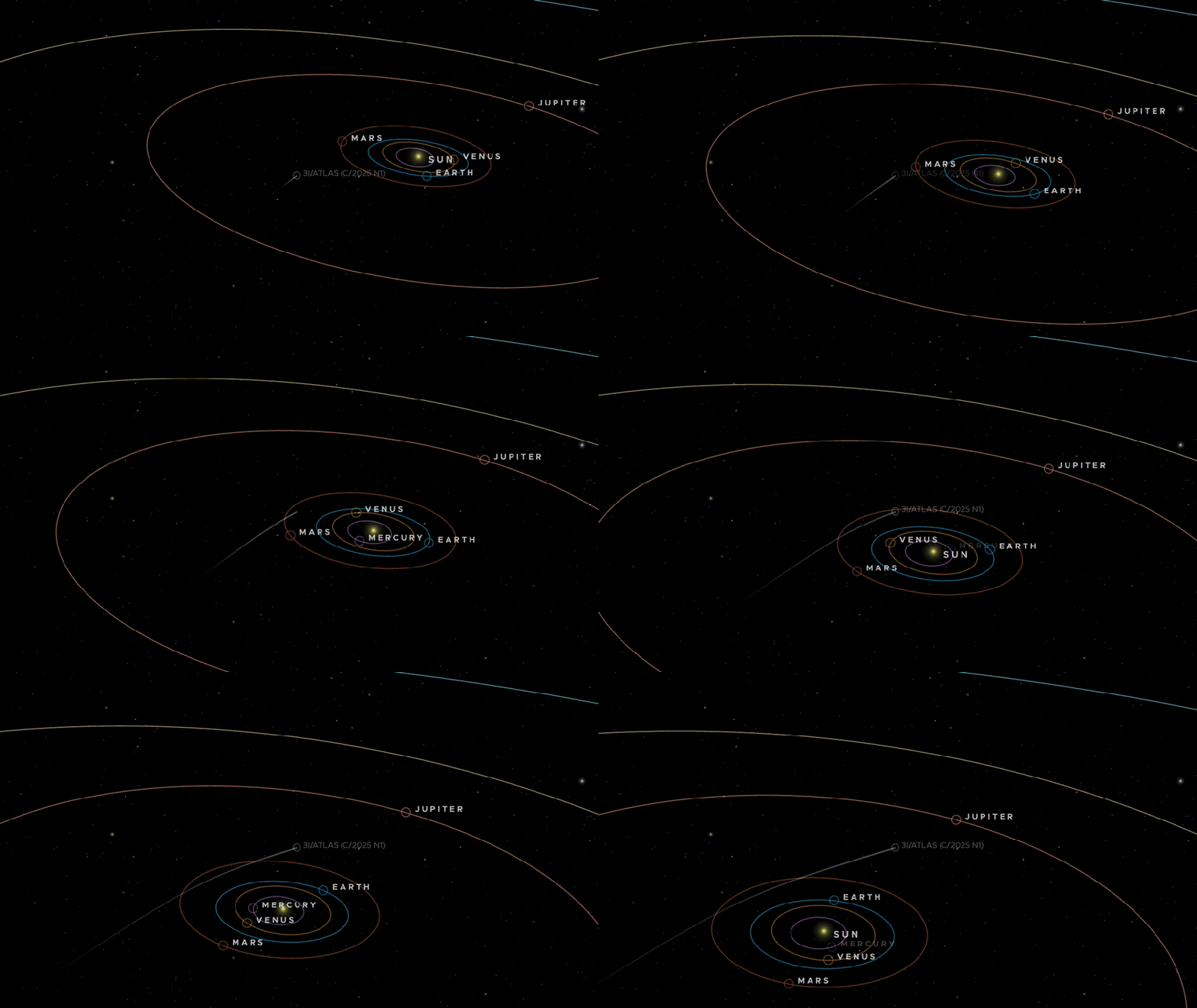
Animation showing Comet 3I/ATLAS as it moves through our solar system. NASA/JPL
RELATED: Earth has a new temporary mini-moon: Meet 2025 PN7
Local perspective:
The comet had been visible by telescope through September, before it got too close to the sun, and is likely to reappear in December on the other side of the sun.
The Hubble Space Telescope captured a picture of the comet back in August.
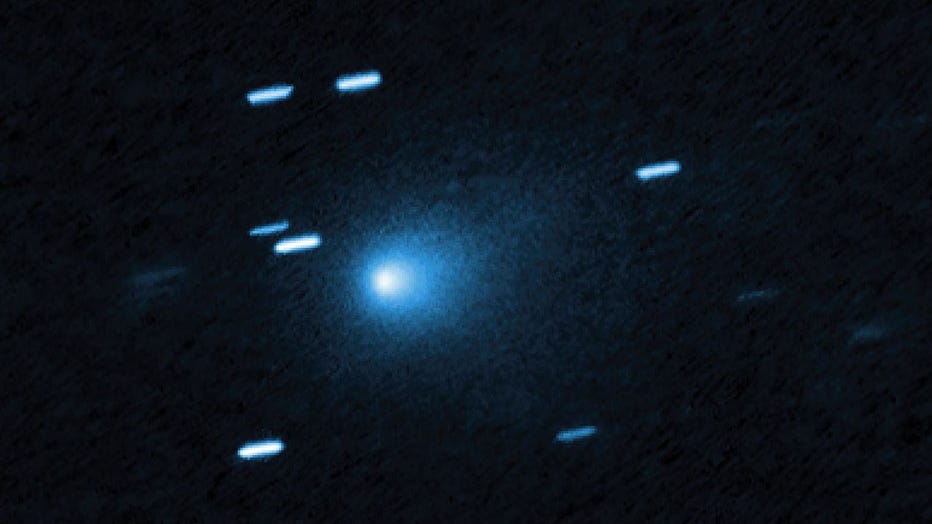
Hubble captured this image of the interstellar comet 3I/ATLAS on July 21, 2025, when the comet was 277 million miles from Earth. Hubble shows that the comet has a teardrop-shaped cocoon of dust coming off its solid, icy nucleus. Image: NASA, ESA, Dav
Dig deeper:
Images revealed a teardrop-shaped plume of dust around the nucleus as well as traces of a dusty, extending tail.
By the numbers:
Observations by the Hubble Space Telescope put the comet’s nucleus at no more than 3.5 miles across. It could be as small as 1,444 feet, according to NASA.
3I Atlas comet latest
Presently:
Space.com reported this week that a team of scientists from the Instituto de Astrofísica-Pontificia Universidad Católica de Chile and Michigan State University detected nickel in the gas surrounding the comet, providing new insight into the chemistry of materials from beyond our solar system.
RELATED: Massive comet zooming through solar system could be alien technology, Harvard astrophysicist says
Avi Loeb astrophysicist theory
The other side:
Harvard astrophysicist Avi Loeb has been closely tracking this object and exploring the possibility that it could be alien technology.
What they're saying:
Loeb spoke with FOX 32 Chicago this week to say scientists have noticed the comet has looked different in continuing photographs, mostly because its glow is changing direction and has been seen going towards the sun and away from the sun.
He says new photos and data of the comet may be in the hands of NASA, but aren’t able to be processed and released due to the government shutdown.
Meanwhile, he said they’re watching the object closely now as it passes behind the sun on Oct. 29.
"The problem is, we can’t observe it from Earth because it’s on the opposite side of the sun. So when you look at the sun during the daytime right now, 3I/Atlas is flying behind it — perhaps for a reason," he said. "If it’s a technological object, that’s the best time for it to do a maneuver to take advantage of the sun’s gravity. That’s what we do with our own spacecraft.
"So the question is, will it appear on a different path after passing close to the sun? Of course, if that happens, the stock market may crash because it would mean that we have some risk involved," he said with a smile, hinting at the end of the Earth à la the dinosaurs. "However, if it continues along its original path, it could still be that it releases some probes that go to the various planets and maneuver. So we should keep our eyes on this ball of light to figure out if it’s natural or technological," he said.
Bottom line:
He says experts and intelligence agencies always acknowledge low-probability events that would have huge implications, but that interstellar objects will become more common in our universe as our detection enhances.
"The question is, what kind of plan should we make in case we notice some alien technology," he said. "It’s something we haven’t discussed in the past and I think we should."
The Source: Information in this article was taken from NASA, a Space.com report, and from comments given by Harvard astrophysicist Avi Loeb. Background information was taken from The Associated Press. This story was reported from Detroit.