

Texas considers wood quarantines after invasive pest found in 3 new counties
YOUNG COUNTY, Texas - The Texas A&M Forest Service has confirmed the presence of the emerald ash borer in Young, Montague and Clay counties after adult beetles were captured in agency monitoring traps, expanding the known range of the destructive pest in Texas.
What is the Emerald Ash Borer?
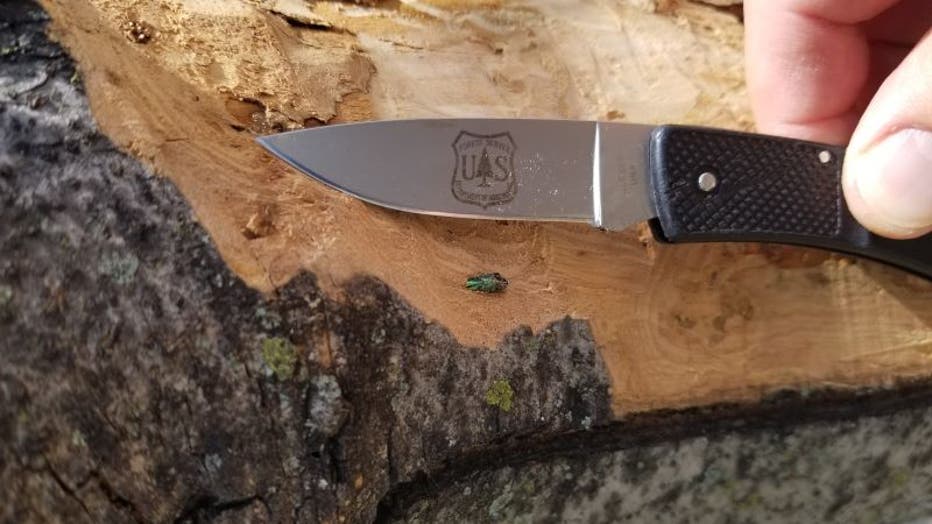
(Texas A&M Forest Service)
Local perspective:
The emerald ash borer is an invasive wood-boring beetle native to eastern Asia that attacks and kills ash trees.
The insect was first detected in North America in 2002 near Detroit and has since spread to 36 states, including Texas. Since arriving in North America, the emerald ash borer has killed millions of ash trees. All 16 native ash species found in the United States are susceptible to attack.
The first Texas detection occurred in Harrison County in 2016. Texas A&M Forest Service uses a network of purple monitoring traps across the state to detect emerald ash borer populations and track their spread into new areas. Information gathered through the monitoring program helps foresters, landowners and communities determine where the insect is present and guides management efforts.
What they're saying:
"Monitoring is one of our most important tools for tracking the spread of emerald ash borer in Texas," Allen Smith, forest health program manager for Texas A&M Forest Service, said in a statement. "These detections help us better understand where the insect is present so landowners and municipalities can implement management strategies as it continues to move across the state."
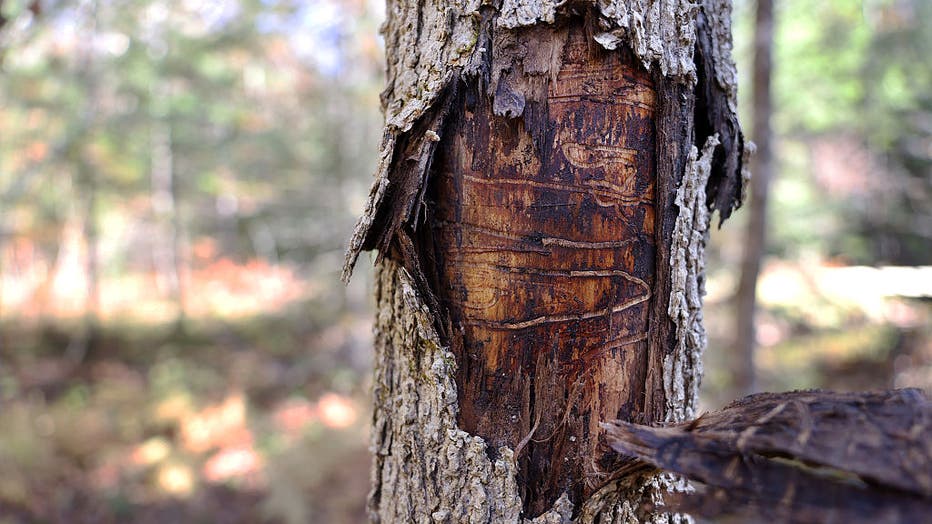
LIMERICK, ME - OCTOBER 18: Telltale signs of emerald ash borer infestation are visible just beneath the bark of this brown ash tree. Drastic steps are underway to save the trees, which are at the heart of the Wabanaki basketmaking tradition. (Staff p
Signs of Emerald Ash Borer infestation in trees
Big picture view:
Adult emerald ash borers are metallic green beetles about one-half inch long. The trees infested by these insects may show signs including thinning canopies, increased woodpecker activity, bark splitting and D-shaped exit holes left by emerging adults.
Larvae feeding beneath the bark create distinctive zigzag or S-shaped galleries, according to the Texas A&M Forest Service.
However, officials noted that ash trees with low populations of emerald ash borers often show few or no external signs of infestation, making early detection difficult and underscoring the importance of monitoring efforts.
How to prevent the spread of the invasive beetle
Dig deeper:
Although the insect spreads naturally as adult beetles move into new areas, people can also unknowingly transport emerald ash borers through infested firewood, logs and other ash wood products. Texas A&M Forest Service encourages residents to buy and burn firewood locally and avoid moving untreated or unseasoned wood.
The agency said it provides resources to help communities identify infestations, evaluate preventative measures and make decisions about tree management and removal.
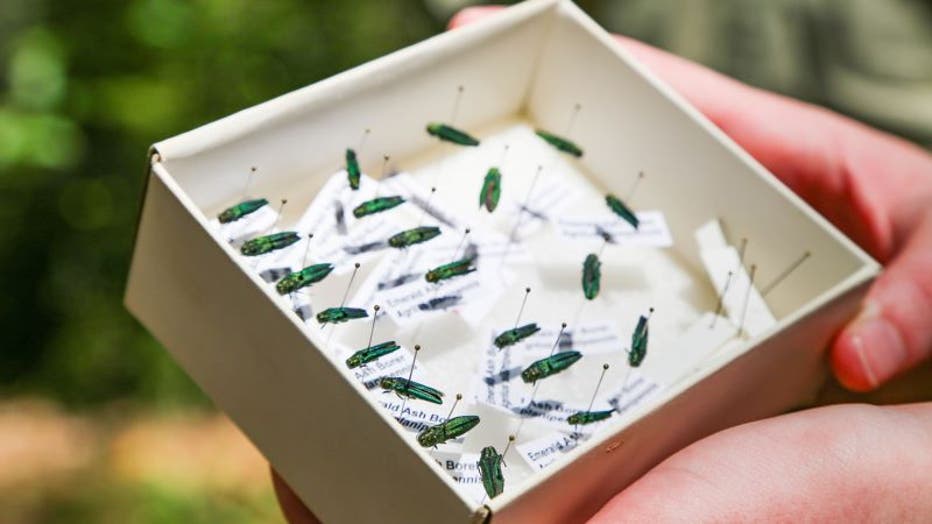
(Texas A&M Forest Service)
Wood quarantines
What's next:
Texas A&M Forest Service will also work with local communities as state officials consider quarantines restricting the movement of wood into and out of affected areas. Such quarantines are a standard response to emerald ash borer infestations and are administered by the Texas Department of Agriculture.
The Source: Information in this article was provided by the Texas A&M Forest Service.