

Milwaukee County Judge Dugan trial: Live updates Wednesday, Dec. 17

Judge Dugan trial: Key testimony from Wednesday
After hearing from several key witnesses, the prosecution rested its case Wednesday in the Judge Hannah Dugan Trial.
MILWAUKEE - The government rested its case against Milwaukee County Judge Hannah Dugan on Wednesday. Federal prosecutors accuse her of helping undocumented immigrant Eduardo Flores-Ruiz evade capture at the courthouse earlier this year.
Live updates from Wednesday, Dec. 17
IN A HURRY? HERE'S A DAY 3 RECAP
Find detailed coverage from Day 3, including bonus coverage with insight from legal experts, below.
Government rests, court breaks for the day
2:43 p.m.:
The government rested its case. Defense Attorney Steven Biskupic said the defense plans to call four witnesses on Thursday. Her attorney appeared to indicate that Dugan would not testify.
U.S. District Judge Lynn Adelman said they are "making good progress." He told jurors that they will get the case "before too long," and he expects to hear closing arguments on Thursday afternoon.

Judge Dugan trial: Government rests its case
WATCH: The government has rested its case in the Judge Hannah Dugan federal trial. The FOX6 News team talks through some of the most pertinent testimony as the trial enters its fourth day of testimony.

Judge Dugan trial: Dugan could not testify in her defense
WATCH: It was learned on Wednesday, Dec. 17 that Judge Hannah Dugan could potentially not testify in her own defense. The FOX6 News team talks through this development with defense attorney Julius Kim.
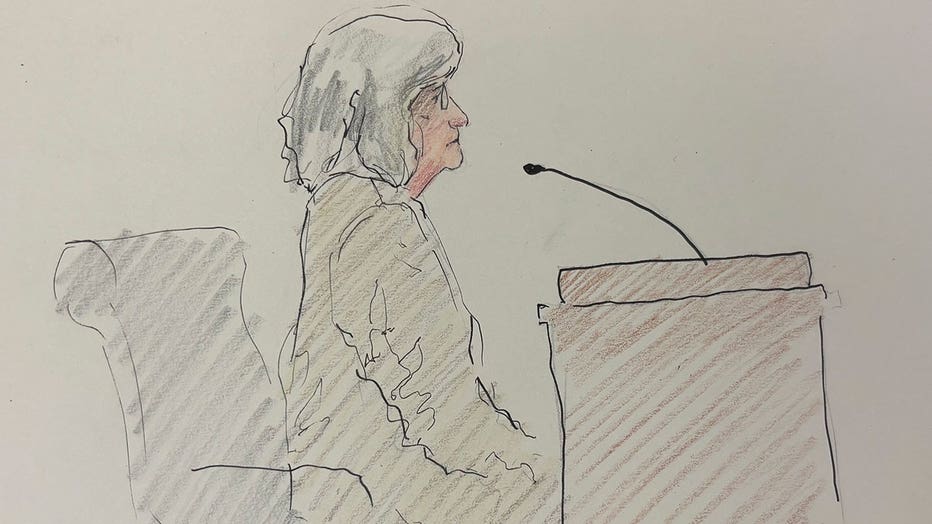
Court reporter Joan Butz testifies in the Judge Hannah Dugan trial on Wednesday, Dec. 17. Sketch courtesy Adela Tesnow.
Joan Butz, Milwaukee County court reporter
Defense cross-examination: Courtroom calendar
2:41 p.m.:
Butz testified about her calendar for courtwork, which noted "Good Friday." She said Dugan went to Mass at noon that day.
On re-direct, Butz clarified a remark about down the "hall" versus down the "stairs."
Government questioning: Conversation about stairs, doors
2:27 p.m.:
The court reporter said Dugan whispered a conversation to her, and she whispered back. She said the conversation involved discussion of "the stairs," and Dugan brought it up first.
Butz testified that she asked Dugan if she needed to show a woman, who she later learned to be Flores-Ruiz's defense attorney, where to go to find the stairs.
Butz said, because she was a newer attorney, there was concern the attorney would not know which door to go through. She said the "wrong" door was the door that led into the public hallway and the door to the stairs would be the "right" door in this instance.
The court reporter testified there was concern about Flores-Ruiz and her attorney going out the "wrong" door. Butz testified that if the attorney and her client went out the "wrong" door, they would encounter the "ICE people."
Butz testified there was concern between her and Dugan that they could get in trouble if Flores-Ruiz and his attorney went out the "wrong" door.
Dugan led Flores-Ruiz and his attorney down the hallway, according to Butz's testimony. She said she did not see which door they went through.
Government questioning: Mention of Flores-Ruiz case
2:23 p.m.:
The government played an audio recording from Dugan's courtroom on April 18. In the recording, Dugan addressed Flores-Ruiz's attorney.
Butz testified that she heard Dugan direct the attorney to take her client out and come back to get a date. She said she had never heard Dugan direct an attorney to do that.
Government questioning: Aware that ICE was at the courthouse
2:21 p.m.:
Butz testified that a deputy clerk of courts alerted her that ICE was in the hallway on April 18. She said that "pisses her off." She remembered the clerk also telling Dugan that ICE was in the hallway.
Butz said she later realized Dugan was no longer in the courtroom. She said Dugan eventually entered the courtroom through the public door wearing her judicial robe.
Government questioning: Official reporter for Dugan's courtroom
2:15 p.m.:
The government called Joan Butz to testify. Butz is a Milwaukee County court reporter, and she is the official reporter for Dugan's courtroom. She was working on April 18.
Butz said part of her routine is looking at the case calendar each day. She keeps a paper copy for herself and marks it with notes for her reference. She crossed out Flores-Ruiz's case, meaning it ended up not being called.
Butz testified it makes a difference for her work whether a case is called on vs. off the record.
FREE DOWNLOAD: Get breaking news alerts in the FOX LOCAL Mobile app for iOS or Android
Judge Adelman allows break
2:00 p.m.:
After the government called a witness, the defense interrupted to request a break so they could address an issue. U.S. District Judge Lynn Adelman excused the jury for 10 minutes.
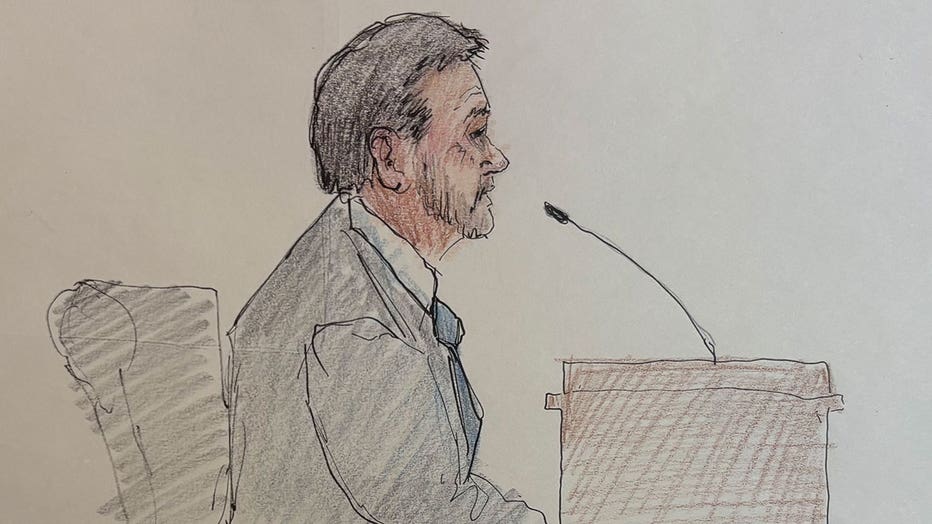
Walter Piel, defense attorney, testifies in the Judge Hannah Dugan trial on Wednesday, Dec. 17. Sketch courtesy Adela Tesnow.
Walter Piel, private practice criminal defense attorney
Defense cross-examination: Order of calling cases
1:56 p.m.:
Piel testified he has handled thousands of cases, and he'd gone with a client into a judge's chamber a number of times.
Piel said there are times when multiple attorneys are trying to have their case heard first or earliest, and it does not always pan out. He said he tried to be first in Dugan's court on April 18, but he was not – and was then late to a subsequent case in Dane County.
The attorney did not feel anything unusual happened in Dugan's courtroom, but he was frustrated that his case was not called first.
Government questioning: Access to restricted area, arrests
1:56 p.m.:
Piel testified, in his 31 years as an attorney, he had never seen a criminal defendant brought through a jury door into a restricted hallway. He did say he, himself, had been in such an area.
Piel said he had seen a number of courthouse arrests in his career.
Government questioning: Flores-Ruiz in Dugan's courtroom
1:48 p.m.:
Prosecutors played audio from Dugan's courtroom in which she asked Flores-Ruiz's attorney to take her client out and come back for a date. Piel said Dugan had never asked him to get a client out and come back to get a date, in his experience.
Piel testified he saw Dugan standing near the jury door in her courtroom and saw a man and a woman walk toward her. He said he heard Dugan telling someone to "come." She said the woman told him she was sorry.
The woman was later identified in court as Mercedes de la Rosa, Flores-Ruiz's public defender.
When Dugan called his client's case, Piel testified Dugan asked if there were victims in the case. He said that was typical for a judge to ask.
Government questioning: Tried to get case called first
1:41 p.m.:
The government called Attorney Walter Piel to testify. Piel is a private practice criminal defense attorney who was in Dugan's courtroom with a client on April 18.
Piel estimated he'd been in front of Dugan more than 50 times in his career. On April 18, he said he hoped to get called first because he had another case in Dane County later that morning.
Piel said Dugan addressed him and said she would call his case first. He recalled Dugan later came in from the area behind him, he thought from the public hallway, wearing her judicial robe, and asked him to step back.
The attorney said he remembered then hearing someone else's name called out, and he stepped aside with his client and sat down.
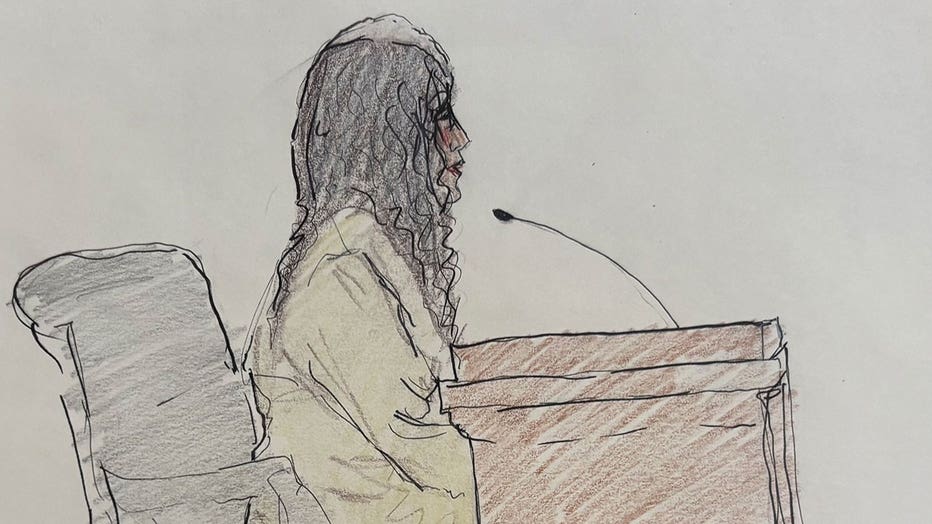
Employee and family service attorney Mercedes de la Rosa testifies in the Judge Hannah Dugan trial on Wednesday, Dec. 17. Sketch courtesy Adela Tesnow.
Mercedes de la Rosa, Flores-Ruiz's public defense attorney
Government re-direct
1:40 p.m.:
de la Rosa said, based on an audio recording, the pace of conversation in the courtroom seemed fairly normal.
Defense cross-examination: Flores-Ruiz in court
1:37 p.m.:
de la Rosa testified that, as a younger attorney, she took the interaction with Dugan in the private hallway as a "mentoring moment." She said their interaction was similar to other mentoring moments in her career, which she said involved a judge – not Dugan – pulling her aside into a private area.
The public defender said she did not see any agents, but later learned there were federal agents at the courthouse on April 18. She has spoken with the FBI a number of times since.
Defense cross-examination: No conversation about stairs
1:29 p.m.:
de la Rosa testified that Flores-Ruiz ran when agents said his name. She said she did not hear the agents identify themselves as law enforcement, and she did not tell her client to run.
The public defender said nobody told her there was a warrant to arrest her client, but knew ICE was there. She said she acted "obnoxious" in court because she did not see an interpreter, which can take hours to get, and she wanted to get Flores-Ruiz in and out as quickly as possible.
de la Rosa said she was not told to go down any stairs, and nobody communicated to her that there were stairs.
While previously working in another county, she said a judge allowed the defense to go out through a private area to avoid disruption.
Government questioning: Outside the courthouse
1:28 p.m.:
de la Rosa testified that she and Flores-Ruiz left the sixth floor of the courthouse and went outside, where federal agents arrested her client.
Government questioning: Through the jury door
1:21 p.m.:
de la Rosa testified that she walked through the jury door of Dugan's courtroom into a hallway. She said she had never been in that area before.
The public defender said Dugan gestured for her to go to the end of the hallway. de la Rosa testified she thought the hallway led into the public hallway, but she felt "scared" and "freaked out," and the situation felt "unusual."
de la Rosa said Dugan stayed with them for a few steps, but not all the way down the hallway. She said she did not know there was a door in that hallway that led to a staircase, and they took a door that led them into the public hallway.
Government questioning: Dugan addresses public defender
1:10 p.m.:
de la Rosa testified that she knew Flores-Ruiz needed an interpreter. She did not remember if she asked or agreed to waive an interpreter.
The public defender said she heard Dugan ask to take her client out and come back for a later court date. She said handling things like that off-the-record was not unusual.
de la Rosa acknowledged hearing a comment about "down the stairs" when prosecutors played an audio recording from Dugan's courtroom – but said she did not hear it on April 18.
de la Rosa said Dugan gestured to her to come to a side door inside the courtroom, next to the jury box. She said Flores-Ruiz was following him around. She did not remember if Dugan opened the door.
Government questioning: Entering Dugan's courtroom
1:03 p.m.:
de la Rosa testified that a fellow public defender alerted her that ICE was on the sixth floor of the courthouse before she found Flores-Ruiz on April 18.
The public defender said, because she knew her client spoke primarily Spanish, she was concerned about the situation. She found Flores-Ruiz and went into Dugan's courtroom, but Dugan was not there at the time.
When they went into the courtroom, she said another attorney was seated at the defense table at that time.
de la Rosa recalled Dugan asking, at one point, "Which client is it?" She testified that Dugan asked her to go to the defense table, and the attorney who was seated there was asked to move away.
Government questioning: Represented Eduardo Flores-Ruiz
1:00 p.m.:
The government called Mercedes de la Rosa to testify. She works for the state public defender's office and represents clients who could not afford an attorney, including Flores-Ruiz.
Brittney Ewing, former DA's Office victim witness advocate
Defense cross-examination: Flores-Ruiz case
12:57 p.m.:
Ewing testified that she was checking a system while in court to see if any off-the-record updates had been entered related to the Flores-Ruiz case.
Government questioning: Flores-Ruiz case, victims
12:53 p.m.:
Ewing testified that Flores-Ruiz had been walking in and out that morning, but she eventually saw him and his attorney walk through the jury door in Dugan's courtroom. She said Dugan was near the door at that time.
Ewing said she did not know what was going on when she saw Flores-Ruiz go through the door, and she had never seen a defendant go through the door. She still expected the case to be called.
Ewing testified she asked another court employee what was going on at some point, and the court employee told her Flores-Ruiz's case was adjourned. She then explained to the victims her understanding of what happened, and the victims appeared "upset" and "confused."
Government questioning: Victim witness advocate covers case
12:45 p.m.:
The government called Brittney Ewing, who was a Milwaukee County District Attorney's Office victim witness advocate on April 18.
Ewing was asked to cover for a case in Dugan's courtroom on that date. She testified it was to meet with victims in the Flores-Ruiz case, and she met with the victims before court that day.
Ewing said one of the victims spoke English and translated on behalf of the group. She relayed to them what they could expect when the case was called.
When Flores-Ruiz arrived in court that day, Ewing said the victims appeared uncomfortable.
COMPLETE COVERAGE: Federal trial of Milwaukee County Judge Hannah Dugan
Judge calls for break
11:56 a.m.:
U.S. District Judge Lynn Adelman called for a lunch break. He ordered court to resume at 12:40 p.m.
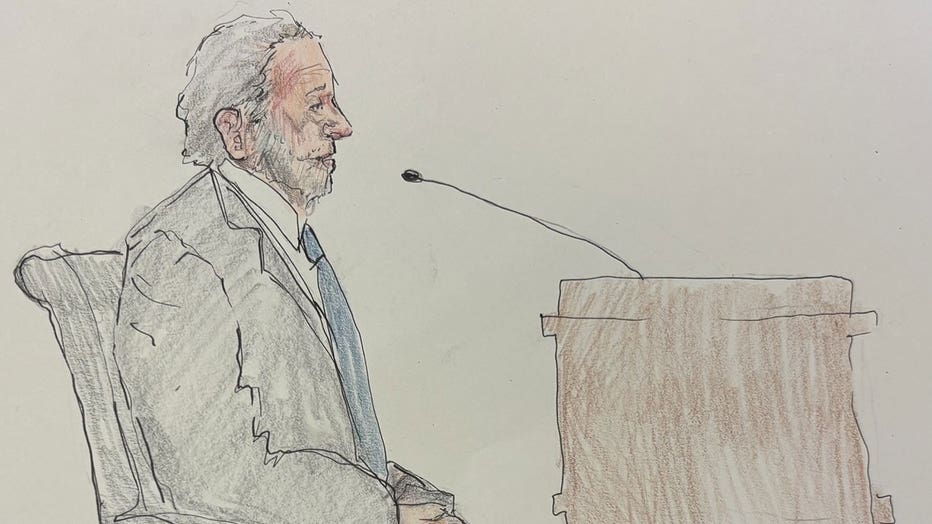
Alan Freed testifies in the Judge Hannah Dugan trial on Wednesday, Dec. 17. Sketch courtesy Adela Tesnow.
Alan Freed, Dugan's court clerk
Government re-direct: Warrant for Flores-Ruiz
11:54 a.m.:
On re-direct from U.S. Attorney Richard Frohling, Freed said that he recalled testifying to a grand jury about a conversation with Dugan about an administrative warrant.
Defense cross-examination: Warrant for Flores-Ruiz
11:45 a.m.:
Freed testified that he knew ICE had an administrative warrant, but did not learn the warrant was to arrest Flores-Ruiz until during or after he'd left court.
Defense cross-examination: On-the-record vs. off-the-record
11:37 a.m.:
Freed testified that it is permissible to call a case with victims off the record. He said on the morning of April 18, Dugan heard nine defendants' cases off the record.
Freed said he had pulled up Flores-Ruiz's case, and knew it needed an interpreter. He said it can be hard to get an interpreter in court. If they cannot get an interpreter, and a case needs to be on the record, it can be rescheduled.
Freed said what Flores-Ruiz's attorney asked Dugan for on April 18 was a matter she would typically agree to hear off the record.
Government questioning: Order of cases, need for interpreter
11:31 a.m.:
Freed said there was no interpreter present in person in the courtroom on April 18. He said they usually call cases with an interpreter first, and acknowledged that Flores-Ruiz's was brought up ahead of someone else's when it was known that ICE was in the public hallway.
The deputy clerk added that another court employee expressed that ICE agents may be on other floors of the courthouse.
Freed testified that, if victims were present for a case and the case was called off the record, the court would typically alert the assistant district attorney about a new date.
Government questioning: Jury door leads to hallway
11:29 a.m.:
Freed did not initially recall seeing Dugan, Flores-Ruiz or his attorney at the jury door. He was shown surveillance video that he said showed all three of those people at the jury door.
Freed said he has seen thousands of cases, and it was the only time he recalled seeing a criminal defendant go through the jury door. He said only a judge can give a criminal defendant permission to go through that door.
Freed testified that the door led to a hallway that leads to a public stairwell and another door. He said that door connects to the public hallway outside Dugan's courtroom, and access was restricted from the other side.
Government questioning: "I'll do it…I'll get the heat."
11:21 a.m.:
The government played audio from Dugan's courtroom from April 18. It recorded a conversation between Dugan and Flores-Ruiz's attorney in which Dugan mentioned "down the stairs."
Freed said he heard another court employee offer to "show them." He said he heard Dugan say: "I'll do it…I'll get the heat." And the other employee said she'd rather get in trouble.
Government questioning: Dugan calls Flores-Ruiz case
11:13 a.m.:
The government played a portion of audio that was recorded in Dugan's courtroom on April 18. After hearing the audio, Freed testified that he believed Dugan called Flores-Ruiz's case "right away" and later told his attorney to get a court date "off the record."
Freed said Dugan asked Flores-Ruiz if an interpreter was needed, and it can take anywhere from a few minutes to an hour to get an interpreter in a courtroom. He said a case with an interpreter is normally called on the record, unless an attorney waives that.
The deputy clerk said he heard someone from Dugan's direction tell Flores-Ruiz's attorney to leave the courtroom and come back. He could not recall if he ever heard a judge tell an attorney to leave and come back without a client.
Freed added that off-the-record cases are typically heard quickly. He said Flores-Ruiz's off-the-record case was quicker than most.
Government questioning: Dugan walking with agent
11:12 a.m.:
Freed was shown surveillance video from the courthouse's public hallway. He recalled Dugan and a man walking past him, and he said he called the man a "fascist." The deputy clerk said he went back into the courtroom.
Government questioning: Audio recorded in Dugan's courtroom
11:04 a.m.:
The government played audio from Dugan's courtroom on April 18. In the recording, Freed said he recognized voices and advised Dugan that there were "ICE guys" in the hallway.
Freed testified he did not call the chief judge because Dugan instructed him not to. He said Dugan then went through a door to her chambers. Freed said he then heard from an attorney in the courtroom that Dugan was in the hallway confronting people, and he "vaguely" recalled poking his head out to see what was going on.
Government questioning: Alerted ICE was at courthouse
11:01 a.m.:
Freed said "one or more" state public defenders mentioned ICE was at the courthouse before court was called for the day. He said he was "upset" and "a little bit outraged." He then walked into the public hallway.
The deputy clerk said he saw agents in the hallway and went back into the courtroom. He did not recall if an interpreter was there for Flores-Ruiz, but said, if an interpreter was there, he would have asked who the interpreter was there for.
Government questioning: Clerk assigned to Dugan's court
10:57 a.m.:
Alan Freed, a deputy clerk of court in Milwaukee County, was called as the government's next witness. He was assigned to Dugan's courtroom and was there on April 18.
Freed testified that he sits to the right of the judge when she's on the bench, and his duties included providing dockets and information.
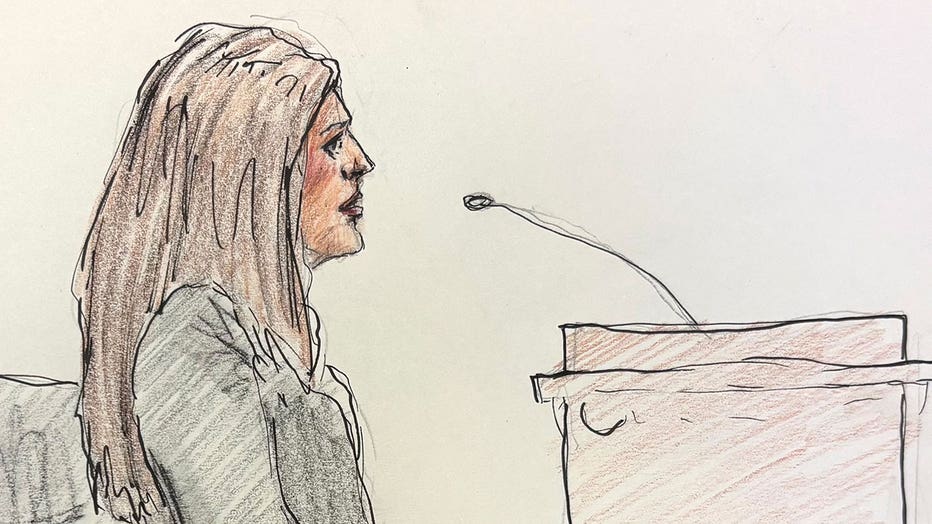
Melissa Buss, Milwaukee County Assistant District Attorney, testifies in the Judge Hannah Dugan trial on Wednesday, Dec. 17. Sketch courtesy Adela Tesnow.
Assistant District Attorney Melissa Buss
Government re-direct: Case calendar
10:53 a.m.:
Buss acknowledged joking about not looking at her calendar as it related to when a case was scheduled, which was brought up during the defense's cross-examination. The government said the case being joked about had been mistakenly calendared for April 19, a Saturday, when she would not typically look at her calendar.
Defense cross-examination: Judge's power in courtroom
10:49 a.m.:
Buss agrees that judges have power to conduct what happens in their courtroom, including where people exit from the courtroom.
Defense cross-examination: Offer to Flores-Ruiz from the state
10:45 a.m.:
Buss testified she sent an email on April 17 – the day before Flores-Ruiz's hearing – in which she sent an offer letter from the state to Flores-Ruiz's attorney. The offer included language for a deferred prosecution agreement, which is handled on a case-by-case basis but could lead to lesser charges or a dismissal.
Defense cross-examination: Happenings in Dugan's courtroom
10:38 a.m.:
Buss testified about the layout of Dugan's courtroom and said April 18 was a busy day.
Buss said she did not hear anything pertaining to Flores-Ruiz's case being called. The defense played an audio recording of Dugan calling the name, which she spoke into a microphone. She agreed, if the judge spoke into a microphone, it would come through speakers in the courtroom.
SIGN UP TODAY: Get daily headlines, breaking news emails from FOX6 News
Judge Adelman allows break
10:23 a.m.:
Defense Attorney Jason Luczak requested a morning break. U.S. District Judge Lynn Adelman excused the jury for 10 minutes.
Government questioning: Dugan calls for Flores-Ruiz case
10:21 a.m.:
Buss said Dugan is the person who decides which cases to call and when. She said she did not recall Dugan calling Flores-Ruiz's case, and she was later informed it was called off the record.
Buss said she was surprised and never learned when Flores-Ruiz's next court date would be, so she was not able to inform victims about the status of the case.
Government questioning: Court notified of ICE's presence
10:16 a.m.:
Buss testified to overhearing that ICE was present at the courthouse. She believes a clerk mentioned it, and Dugan reacted to that by getting up and going into her chambers.
Buss said she later saw Dugan, who was off the bench, motion for Flores-Ruiz and his attorney to come forward toward the jury door. Flores-Ruiz and his attorney went through the jury door, which is typically closed.
She said the jury door from the courtroom leads to Dugan's chambers and a hallway. She said the hallway leads to another door and a stairwell, and it
Government questioning: Assistant district attorney in Dugan's courtroom
10:10 a.m.:
The government called Melissa Buss, a Milwaukee County assistant district attorney who was assigned to Dugan's courtroom on April 18. Attorney Kelly Brown Watzka questioned her.
Buss testified that the calendar for Dugan's courtroom on April 18 included Flores-Ruiz's case. He was scheduled for a pre-trial conference at 8:30 a.m.
The assistant district attorney said a victim witness advocate informed her that victims in the Flores-Ruiz case were present that morning. Buss said, when victims are present, she prefers for cases to be called on the record.
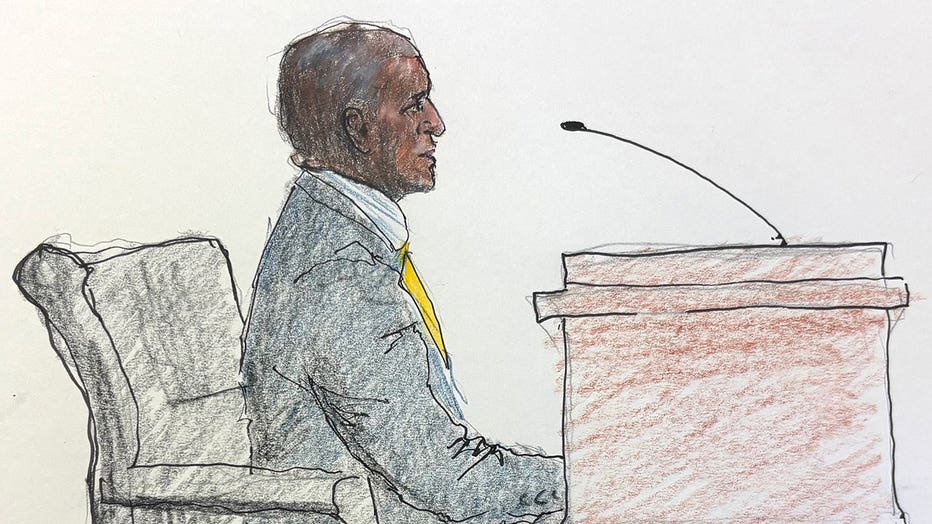
Chief Judge Carl Ashley testifies in the Judge Hannah Dugan trial on Wednesday, Dec. 17. Sketch courtesy Adela Tesnow.
Milwaukee County Chief Judge Carl Ashley
Government re-direct: Disagreement with federal policy, law
10:06 a.m.:
Ashley said his press release about ICE in the courthouse, from April 6, expressed concerns that he took seriously. He said his disagreement with a federal policy or law would not give him authority to interfere with a lawful arrest in a public arrest. Ashley said he did not tell ICE they could not conduct an arrest in a public hallway.
Defense cross-examination: Chief judge reads draft policy
10:01 a.m.:
Ashley was provided a copy of his draft policy. He testified that it included language for court employees to use if ICE attempted to enter a non-public area: "I do not consent, but because I have no other choice at this time, I will not interfere with your order."
Ashley said he got that quote from a similar policy from San Francisco County, California. He said the San Francisco County policy explicitly also stated that ICE could conduct operations in public areas, but he removed that statement when drafting his own policy.
Defense cross-examination: Chief judge's press release about ICE
9:54 a.m.:
Defense Attorney Steven Biskupic cross-examined Ashley. Binders were distributed to Ashley and jurors, and he walked the court through exhibits included in the binder.
Ashley testified the binder included a printout of an April 6 email he sent; it was a press release regarding ICE draining people at the courthouse complex. In that press release, he wrote that ICE agents conducting arrests there posed "significant concerns" about "integrity and impartiality in the judicial system."
Ashley's email said ICE's presence could have a "chilling effect on access to justice," cause people to "perceive courthouses as unsafe due to fear of detention," lead to "confusion over legal protections." He summarized that allowing ICE to operate without the courthouse complex "had the potential to significantly damage the integrity of the court system" and said courts must remains "free from the threats of immigration enforcement."

Judge Dugan trial: Chief judge's testimony, policies
WATCH: The Chief Judge at the Milwaukee County Courthouse testified in the Judge Hannah Dugan federal trial on Wednesday, Dec. 17. The FOX6 News team along with political reporter Jason Calvi broke down some of what was said.
Government questioning: ICE arrest communicated to colleagues
9:50 a.m.:
Ashley said he sent an email on the afternoon of April 18, notifying colleagues that ICE had conducted a courthouse arrest. He detailed what took place and noted ICE's actions were consistent with his draft policy.
The chief judge said Dugan replied to that email the following Monday, and clarified that ICE did not present a warrant in the hallway.
Government questioning: Misunderstanding of arrest
9:47 a.m.:
Ashley said it was his understanding, after speaking to an ICE agent, that the arrest would take place in the public hallway.
The chief judge said he then spoke to a courthouse safety supervisor, who informed him that the arrest did not take place as he anticipated.
Ashley said he then texted Dugan a few times, asking her to call him, and he received a response hours later. He ultimately decided to table any conversation because he was concerned about what might have happened.
Government questioning: Notification that ICE was present
9:40 a.m.:
Ashley said he was at the home when he was notified that ICE was present at the courthouse, and he called his district court administrator – who was at the courthouse – to see if agents were there.
The administrator called Ashley, he said, to say ICE agent(s) were there. He said he was not expecting the call, but he was not surprised. He then spoke to an ICE agent, who was in the chief judge's office, on speakerphone.
Ashley said he asked for a copy of the ICE warrant, the agent complied, and the chief judge reviewed the administrative warrant. He was unsure how many people were in the room while the call was on speakerphone. The ICE agent asked for the call to take place in a more private area, and he agreed that would be OK.
Ashley testified that his draft policy, at that time, had not yet been sent to ICE. The conversation with the agent then turned to that policy, and he told the agent that he did not believe they could stop them from conducting an arrest in a public hallway. He described the conversation as "amicable."
Government questioning: Administrative vs. judicial warrants
9:36 a.m.:
The draft policy also said, according to Ashley's testimony, an ICE administrative warrant authorized them to conduct an arrest – but that such a warrant did not compel courthouse personnel to let ICE into non-public areas or search certain records.
Ashley testified that a judicial warrant, on the other hand, would grant ICE access to a non-public space if necessary. He still expressed concern that doing so could be disruptive to court activities.
Government questioning: Communication about draft policy
9:28 a.m.:
Ashley said he sent a draft policy with an attachment from U.S. Immigration and Customs Enforcement, notifying judges about what they should expect about courthouse arrests, on April 9.
The chief judge testified that "system partners" would have to vet the draft policy – including corporation counsel, the sheriff's office and others. He also sought input from ICE.
Ashley said he conducted a Zoom meeting in which he said he believed they were unable to control what happens in public hallways. He believes Dugan was not at that meeting, but was hesitant to say she was not in attendance.
At that point, Ashley said the draft policy was not official policy. However, the draft policy said employees would be responsible for notifying the district court administrator and chief judge about ICE activity at the courthouse.
Government questioning: Emails discuss ICE at courthouse
9:18 a.m.:
Attorney Keith Alexander questioned Ashley in the government's case. Ashley has been a judge for 26 years, all with Milwaukee County, and has been chief judge since April 2023.
Ashley testified he emailed all Milwaukee County judges on April 3, 2025. In that email, he notified them about an ICE arrest at the courthouse complex that happened in March. He expressed uncertainty about how, if at all, the courts had the authority to intervene in an arrest that was happening in a public hallway.
The chief judge testified he does not believe the judiciary has the authority to intervene.
Ashley said he and others received guidance in response to his email on April 4 that ICE can legally conduct enforcement in public areas of the courthouse, and there are "statutory and policy limitations" to such enforcement.
Ashley testified that Dugan replied, thanking the sender for the information and asking for at least a draft policy on how to handle immigration enforcement operations.
Milwaukee County District Court Administrator Stephanie Garbo
Defense cross-examination: How long was the phone call?
9:14 a.m.:
Attorney Steven Biskupic cross-examined Garbo. She said she could not recall whether there was discussion about whether a courtroom is a non-public space, as it relates to where ICE could conduct arrests.
During cross-examination, the government's re-direct and the defense's re-cross, Garbo was asked to recall how long the call lasted between Chief Judge Carl Ashley and the agent.
Government questioning: Questions about courthouse policy
9:11 a.m.:
According to Garbo, she said Chief Judge Carl Ashley was primarily discussing a draft policy regarding ICE at the courthouse with an agent. She had it was her understanding that the policy was still in draft form, and there was no interim policy on April 18.
Garbo testified there was discussion about a warrant, and Ashley asked her to make a photocopy of it. She then sent a digital copy to Ashley.
Garbo said Ashley and ICE had a "professional" conversation about arrests, but she did not recall specifics. She said the courthouse's public hallways were available for arrests.
Government questioning: Calls with the chief judge
9:03 a.m.:
The government called Stephanie Garbo, administrator for Milwaukee County district court, as its first witness on Wednesday. Garbo was working at the courthouse on April 18.
Garbo testified that Chief Judge Carl Ashley called and told her he believed ICE agents were coming to Dugan's court that day. She said she noticed two men sitting on a bench – later identified as ICE agents – and Ashley did not ask her to interact with agents, check to see if they had a warrant or bring them to his office from the public hallway.
Garbo said Judge Kristela Cervera and an agent later came back to the chief judge's office, and she arranged a call between the agent and Ashley. She said another agent was present but did not participate in the call.
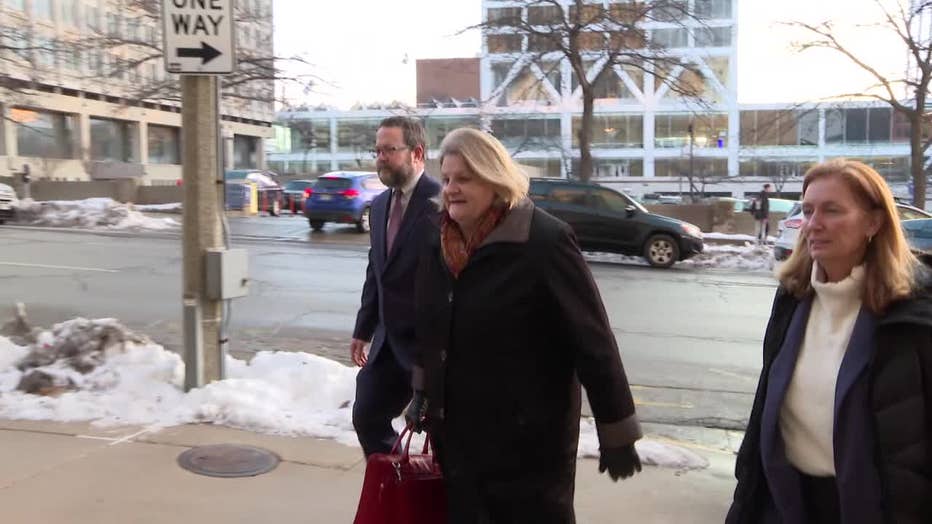
Judge Hannah Dugan enters federal court on Wednesday, Dec. 17, 2025.
Judge Adelman calls court into session
9:02 a.m.:
The 13-person jury was brought into the courtroom for a third day of testimony in the trial. U.S. District Judge Adelman said: "We're making good progress."
Bonus coverage from Wednesday, Dec. 17

Legal expert talks Judge Hannah Dugan trial day 3
The prosecution rested Wednesday in the federal trial of Judge Hannah Dugan, who is accused of helping an undocumented immigrant evade ICE agents.

Judge Dugan trial: Political undertones of case
WATCH: There are a lot of political overtones tied to the Judge Hannah Dugan federal trial. UWM Professor Emeritus Mordecai Lee joined the FOX6 News team to talk about this aspect of the case -- and offer in-depth analysis.

Judge Dugan trial: Pivotal testimony as prosecution wraps
WATCH: The FOX6 News team breaks down the most pivotal testimony in the Judge Hannah Dugan trial on Wednesday, Dec. 17 -- and talks about the prosecution's efforts to prove Judge Dugan's intent in this case.

Judge Dugan trial: Day 3 testimony, early headlines
WATCH: Day 3 of testimony in the Judge Hannah Dugan trial unfolded quickly on Wednesday, Dec. 17. The FOX6 News team including anchor Ted Perry broke down some of the key points shared early in the day.

Takeaways from day 2 of Hannah Dugan trial
Immigration attorney and criminal defense attorney Marc Christopher joins FOX6 WakeUp to talk about the Judge Dugan trial.
Dugan charged
The backstory:
A federal grand jury indicted Dugan, and she pleaded not guilty, in May.
The grand jury's two-count indictment accused Dugan of helping an undocumented man, Eduardo Flores-Ruiz, evade federal agents who were at the Milwaukee County Courthouse to arrest him on April 18. It also states Dugan obstructed those agents in the process.
Flores-Ruiz was in Dugan's courtroom for a misdemeanor battery case. Prosecutors said Dugan told federal agents to go to the chief judge's office down the hall, and she is then accused of telling Flores-Ruiz and his attorney to leave her courtroom through a back door as federal agents waited outside the courtroom to arrest him.
Milwaukee County Judge Dugan trial: How does federal court work?
Jury selection in the federal trial of Milwaukee County Judge Hannah Dugan begins Thursday. So how does federal court work?
Agents arrested Flores-Ruiz outside the courthouse after a brief foot chase that day. Dugan was arrested by federal agents at the Milwaukee County Courthouse on April 25.
The Wisconsin Supreme Court later suspended Dugan indefinitely after she was arrested and charged. Flores-Ruiz later pleaded guilty to illegally reentering the U.S. and, in November, was deported.
Federal Judge Lynn Adelman is overseeing the Dugan trial.
Complete coverage
Dig deeper:
FOX6 News will stream special coverage of the Dugan trial each day on FOX LOCAL. The app is free to download on your phone, tablet or smart TV.
- Day 2: Fellow judge, federal agents testify to what happened at courthouse
- Day 1: Opening statements; FBI agents, ICE supervisory officer testify
- Dec. 11: Judge Dugan trial: Jury seated after day of questioning
- Judge Dugan trial: How did we get here?
- Judge Dugan trial: Who is Eduardo Flores-Ruiz?
- How does federal court work?
- Courthouse immigration enforcement policy questions remain
The Source: FOX6 News reviewed court filings and video associated with the case, is at the federal courthouse for the trial and referenced prior coverage of the case.