

Ranking adult literacy rates across the Midwest

A person sits on a sofa and reads. (Juliane Sonntag/Photothek via Getty Images / Getty Images)
MINNEAPOLIS (FOX 9) - States across the Midwest vary in their English literacy levels, with Minnesota ranking the highest in the region.
A survey completed by the Program for the International Assessment of Adult Competencies (PIAAC) ranked U.S. adults (those aged 16-65) by their literary proficiency level. Here's what the survey found.
Minnesota's literacy rate
Ranking No. 2:
Out of 52 ranked states and territories, Minnesota came in as the second-highest scorer for literary proficiency.
Minnesota had an adult literary proficiency score of 278.8, whereas the top spot went to New Hampshire, which had a score of 278.9, according to PIAAC.
North Dakota's literacy rate
Local perspective:
North Dakota was the second-best performing Midwest state in the ranking. It was placed at no. 7 out of 52 states for its adult literacy score of 275.9.
Iowa's literacy rate
Local perspective:
Iowa was ranked relatively high on the list from the survey as well. The state received a score of 273.5 in literary proficiency.
Midwest literacy rate rankings
By the numbers:
- Wisconsin placed at No. 13 with a literary proficiency score of 273.
- South Dakota placed at No. 21 with a literary proficiency score of 271.1.
- Michigan ranked No. 22 with a score of 270.9.
- Ohio ranked No. 26 with a score of 268.5.
- Indiana ranked No. 28 with a score of 266.3.
- Missouri placed No. 30 with a score of 266.
- Illinois was listed at No. 32 with a score of 265.6.
Full literacy rate ranking
Big picture view:
The highest literacy scores went to New Hampshire, Minnesota, Alaska, Washington, D.C., and Vermont. While the lowest literacy scores were seen in New Mexico, Louisiana, Mississippi, Texas, and Nevada.
Below is a full list ranking of how each state and territory was rated in its adult literacy score, according to PIAAC.
- New Hampshire - 278.9
- Minnesota - 278.8
- Alaska - 276.7
- District of Columbia - 276.7
- Vermont - 276.7
- North Dakota - 275.9
- Washington - 274.7
- Utah - 273.9
- Iowa - 273.5
- Oregon - 273.2
- Maine - 273.1
- Wisconsin - 273
- Massachusetts - 272.9
- Montana - 272.8
- Wyoming -272.4
- Colorado - 272
- Nebraska - 271.5
- Connecticut - 271.4
- Kansas - 271.3
- South Dakota - 271.1
- Michigan - 270.9
- Hawaii - 270.3
- Virginia - 270
- Idaho - 269.8
- Ohio - 268.5
- Maryland - 268.1
- Indiana - 266.3
- Pennsylvania - 266.2
- Missouri - 266
- Rhode Island - 266
- Illinois - 265.6
- North Carolina - 265.5
- New Jersey - 264.3
- Delaware - 264
- Oklahoma - 263
- South Carolina - 262.9
- Arizona - 262.4
- Kentucky - 261
- Georgia - 260.4
- Tennessee - 260.1
- West Virginia - 259.8
- New York - 259.7
- Alabama - 258.9
- Florida - 258.9
- Arkansas - 258.7
- California - 257.2
- Nevada - 254.9
- Texas - 253.6
- Mississippi - 251.7
- Louisiana - 251.5
- New Mexico - 251.5
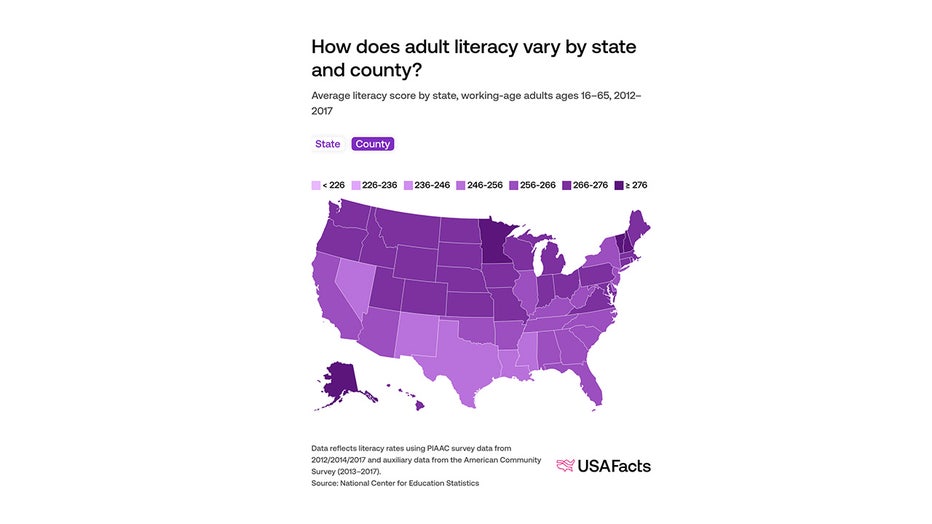
Source: USAFacts (USAFacts )
How literacy rates were determined
Dig deeper:
PIAAC created a system to determine the literacy rates of adults across the United States. The chart below, created by USAFacts, shows the details of what the different scores mean for the average literacy rates of U.S. adults.
The average scores for adults across all states and territories were largely within the level 2 literacy proficiency level range, with some states' averages creeping into the level 3 category.
The national average literacy score is 263.5, which would place the entire nation's average at level 2.
Growing national literacy crisis
Why you should care:
The number of adults performing at the lowest literacy score went up 9 percentage points between 2017 and 2023, according to USAFacts. This increase is the first statistically significant one since 2012, when the data were first collected by PIAAC.
Literacy is defined by PIAAC as "understanding, evaluating, using and engaging with written text to participate in the society, to achieve one's goals and to develop one's knowledge and potential."
PIAAC measures the competency of working-age adults for literacy, numeracy, and digital problem-solving.
A caveat in the study is that all U.S. PIAAC literacy results are analyzed for English literacy only. This could potentially explain why some states rank lower, as they might have more immigrant residents that do not speak English as a first language.
According to USAFacts, 28% of adults in the U.S. believe it is difficult to compare and contrast information, paraphrase, or make low-level inferences. This information and data went into how PIAAC rated their literacy score.
Scores were based on how many points a person got from doing tasks of increasing difficulty. The more tasks the person successfully completed at a higher level determined how high their overall score was.
What's driving the literacy crisis?
The backstory:
According to the nonprofit organization, ProLiteracy, 59 million adults in the U.S. — or about one-third — read at or below Level 1, which is the lowest level out of 5. This means those people can only read short sentences with basic words and information.
Poverty is a major driver of the adult literacy crisis in the United States, according to ProLiteracy. About 80% of people who live in poverty read at Level 2 or below.
Educational opportunities, parents' literacy level, school's performance, and economic hardship all impact a person's literacy rate.
Dig deeper:
Other potential factors impacting literacy scores involve learning disabilities or differences, especially when there is a lack of diagnosis.
People with disabilities, such as dyslexia, often struggle with reading comprehension, spelling, writing, and decoding words — all of which are crucial to literacy. Without proper assistance and intervention for learning disabilities, many will continue to struggle with literacy.
Limited access to educational programs also plays a role in literacy scores. People who score lower on literacy rates could likely benefit from adult educational opportunities. However, less than 10% are enrolled in any of these programs, largely due to exterior barriers.
Those who are located in rural and economically disadvantaged areas, where low literacy rates are often higher, face barriers to accessing adult education programs. This perpetuates the literary crisis for adults and creates "literary deserts", according to ProLiteracy.
Of those with low literacy skills, 80% said that they don't know about these programs, making them less likely to seek them out. Work schedules, transportation hurdles, and demands of childcare also prevent people from attending adult education.
Additionally, feelings of shame might contribute to people not attending programs. While a lack of funding and volunteers to run the programs creates issues in maintaining the programs. ProLiteracy estimates that in 2024, about 63% of literacy programs had waiting lists.
The Source: Information for this article was sourced from the National Center for Education Statistics, the Program for the International Assessment of Adult Competencies, USAFacts, a national, nonpartisan data collection organization, and ProLiteracy, a nonprofit organization promoting literacy. This story was written from Eden Prairie, Minnesota by Maureen Breslin.