

Why fall should actually begin on September 1

Meteorological fall vs. astronomical fall
As meteorological fall gets underway on Sept. 1, FOX Weather meteorologists Michael Estime and Marissa Torres explain the differences between meteorological fall and astronomical fall, which doesn't begin until Sept. 22.
Fall might not officially begin until Sept. 22 with the autumnal equinox, but meteorologists and climatologists actually consider Sept. 1 the beginning of autumn.
This is because the astronomical seasons are based on the Earth's position relative to the Sun, while "climatological" or "meteorological" seasons are divided into three-month periods based on the temperatures that would be expected during each season.
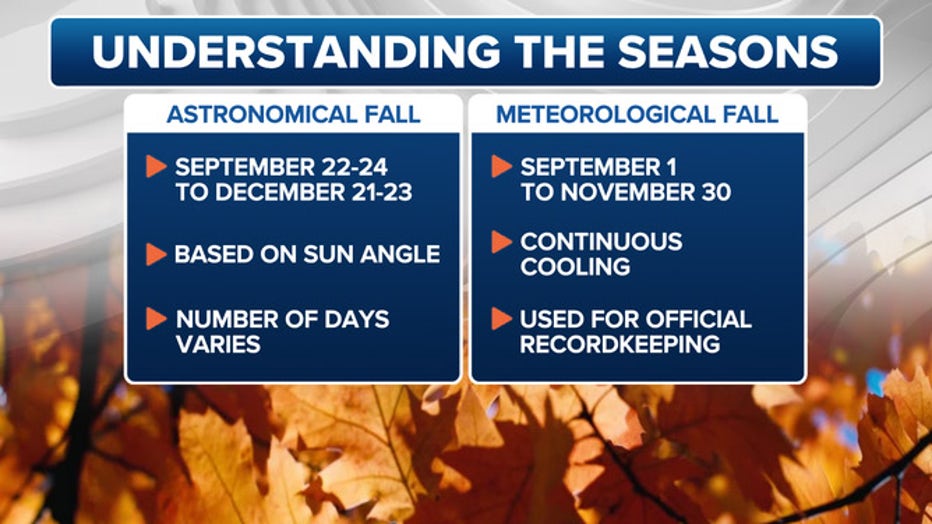
The start of fall depends on whether you're referring to the astronomical or the meteorological start. (FOX Weather)
For example, summer is the hottest time of the year and winter is the coldest time of the year, with fall and spring being the transition seasons. So, instead of focusing on the Earth’s orientation to the Sun, these so-called meteorological seasons are solely classified by the annual temperature cycle across the world.
The hottest three months of the year in the Northern Hemisphere are June, July and August, so meteorological summer runs from June 1 to Aug. 31.
KNOW YOUR HEAT TERMINOLOGY: EXTREME HEAT WARNING, EXTREME HEAT WATCH AND HEAT ADVISORY
Conversely, December, January and February are the Northern Hemisphere’s coldest three months, so meteorological winter runs from Dec. 1 to Feb. 28 (or Feb. 29).
The transition seasons are the three months between summer and winter, so meteorological fall is Sept. 1 to Nov. 30 and meteorological spring is March 1 to May 31.
Featured

What are the worst times to travel home on Labor Day?
The Labor Day holiday weekend is coming to an end, and the last thing you want is to ruin that relaxed and refreshed feeling after taking one last summer vacation by getting stuck in heavy traffic on your way home.
Splitting the seasons into these nearly equal three-month periods makes seasonal recordkeeping much easier since the start and end dates of the seasons are always the same. Additionally, each meteorological season is always 90 to 92 days, depending on whether it's a leap year or not.
DOWNLOAD THE FREE FOX WEATHER APP
The dates of the solstices and equinoxes can vary by a day or two each year, so an apples-to-apples comparison of seasonal temperatures or precipitation would become a nightmare for our friends at the National Weather Service if they didn't use meteorological seasons.
In 2025, astronomical fall officially begins Sept. 22 with the autumnal equinox at 2:19 p.m. EDT. That's simply the precise moment in time when the Sun will be in direct alignment with the equator. Therefore, everywhere on Earth will experience an equal 12 hours of day and night on that date.
SEPTEMBER WEATHER OUTLOOK PITS WARM FORECASTS AGAINST COOL SIGNALS
Since the Earth is tilted approximately 23.5 degrees off a vertical axis, the most direct sunlight is aimed at the Northern Hemisphere during our astronomical summer. That means the days will continue to grow shorter through the fall until the winter solstice on Dec. 21 because the most direct sunlight shifts into the Southern Hemisphere during our astronomical winter. Thereafter, the days will turn longer until the summer solstice on June 21.
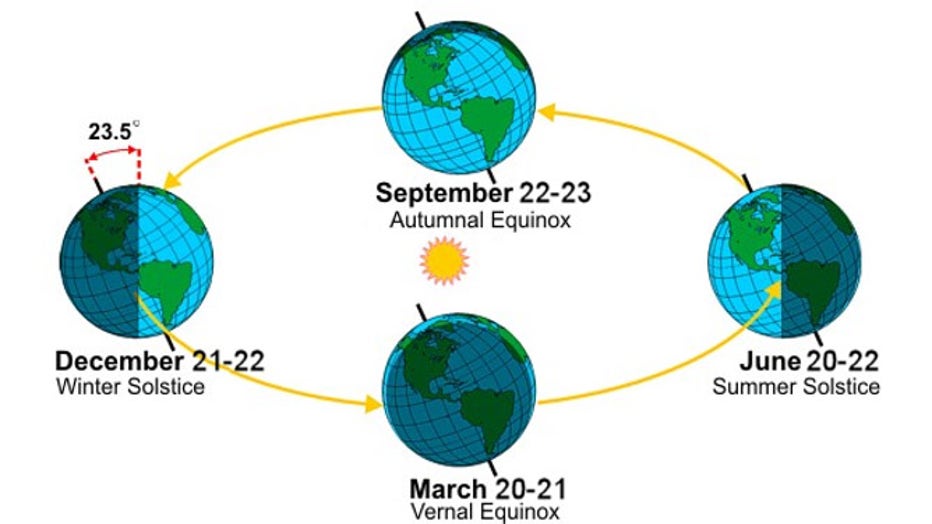
The Earth's orbit around the Sun gives our planet its four seasons. (NOAA)