

2026 midterm elections: Races for governor across the US
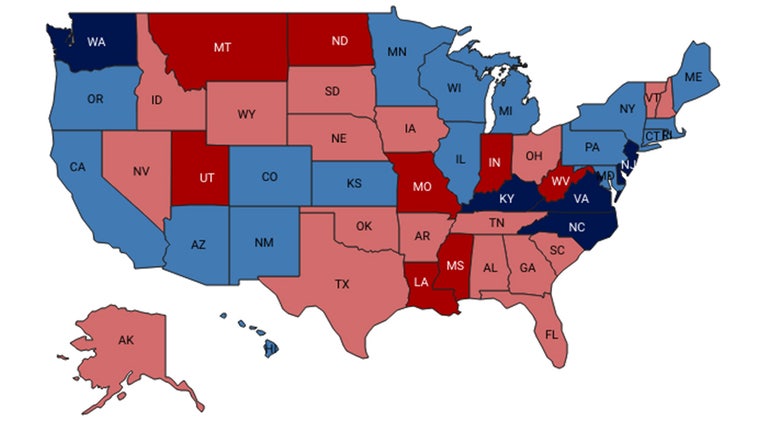
A map showing partisan control of gubernatorial offices in the U.S. The states in lighter shades have elections in November 2026. (FOX TV)
Amid the nationwide fight between Democrats and Republicans over who will control the House and Senate in Washington after Election Day are dozens more skirmishes that will decide which party wields the levers of power in state capitals across the country.
For one party, this November’s elections offer a chance to do something that it has been unable to do for more than a decade: control a majority of the governors’ mansions.
Big picture view:
Ever since 2010, Republican governors have outnumbered their Democratic counterparts, and for a few years, it was not even close. By 2018, the GOP controlled more than twice as many governors’ seats as Democrats (33 to 16, with one independent). Since then, the gap between the two parties has narrowed, and the Republican edge has been whittled down to two seats.
By the numbers:
Across the country, the midterm elections will include 36 gubernatorial races. While all of those races could technically go either way, the number of races that are seen as still being up for grabs is much lower.
In reality, fewer than a third of those seats are still considered competitive by many pundits, and the competition for governors’ offices will likely come down to just a handful of those.
Georgia's governor race
With current Gov. Brian Kemp prevented from running again because of term limits, Democrats in Georgia are eyeing an opportunity to break the Republican grip on state government that has held for more than two decades.
Former Atlanta Mayor Keisha Lance Bottoms looks to become the first Democrat elected governor in the Peach State since 1998, and, in the process, she could break an even more historic barrier. Lance Bottoms is one of two gubernatorial candidates, along with Republican Lisa Demuth in Minnesota, who could become the country’s first-ever Black woman governor.
Lance Bottoms will face off in November against Rick Jackson, who is looking to help maintain the Republican Party’s hold on the governor’s mansion and the state legislature. Going into late September, polls predicted a tight race; however, as the month came to a close, a crack of daylight began to open between Jackson and Lance Bottoms.
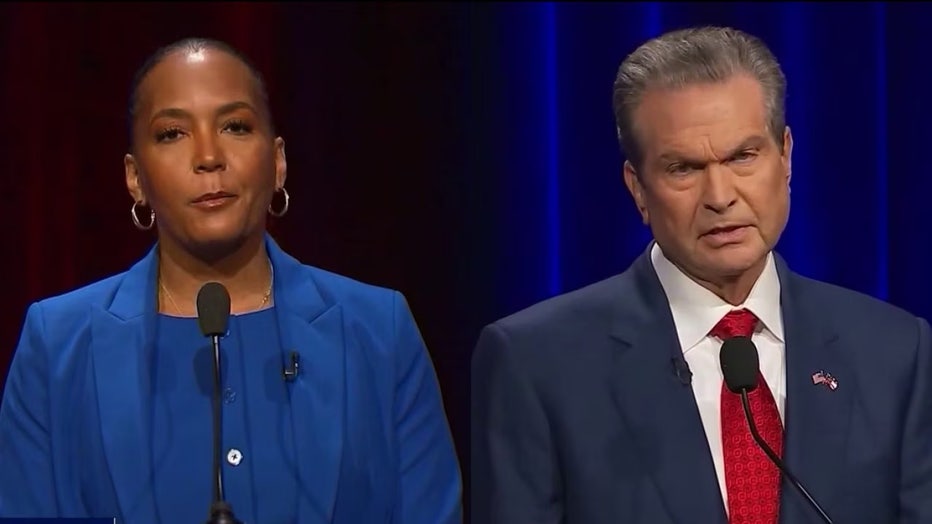
Democratic Candidate Keisha Lance Bottoms and Republican Candidate Rick Jackson prepare for their televised town hall debate at the State Capitol as voter registration closes in Georgia. (WAGA)
Georgia governor candidates
Rick Jackson
Jackson already overcame one big hurdle in his pursuit of the governorship: President Donald Trump’s endorsement of the other candidate. The billionaire founder and CEO of Jackson Healthcare poured over $100 million of his own money into his campaign to defeat the president’s pick, Burt Jones, in the Republican runoff in June and secure the nomination.
The Republican nominee has promised to grow Georgia’s economy by expanding access to capital and practical training for small businesses and entrepreneurs throughout the state. He has called for freezing property taxes and cutting the state income tax in half over the next four years, while using artificial intelligence and technology to cut wasteful spending. He also plans to freeze tuition, room, and board at public colleges and technical schools.
Keisha Lance Bottoms
A former judge and Atlanta City Council member, Lance Bottoms was elected in 2017 to serve as mayor of Georgia’s capital. Opting not to run for re-election, she took a role in then-President Joe Biden’s administration as the director of the Office of Public Liaison. She later moved to the President’s Export Council, where she served until President Donald Trump took office.
Lance Bottoms pushed for raising the state’s minimum wage to $15 an hour and creating tuition-free community and technical colleges. A supporter of expanding Medicaid, an issue that Jackson has also backed, Lance Bottoms described expansion as a "day-one" priority that she said would cover an estimated 300,000 uninsured Georgians.
Nevada's governor race
Incumbent Governor Joe Lombardo is facing a tough test as the one-term Republican goes against an opponent who has proven he knows how to win statewide elections. Aaron Ford won the state’s attorney general seat in 2018 and was reelected four years later in the same election that sent his opponent to the governor’s mansion.
Just hours after the two men secured their respective nominations, The Associated Press’s Jessica Hill was describing the Silver State’s gubernatorial race as one of the most competitive in the country, noting that Lombardo was considered one of the most vulnerable incumbents this year. At the top of voters’ minds when they head in to cast their ballots in November will be affordable housing, exploding energy demand from artificial intelligence centers, and federal cuts to state programs.
In the last presidential election, Nevada swung toward President Donald Trump, giving the Republican candidate a three-point win. However, that was the first GOP win in Nevada in a presidential race in 20 years. In a state known for gambling, election handicappers have not settled on an odds-on favorite, with the race being considered a toss-up or lean Republican in recent weeks.
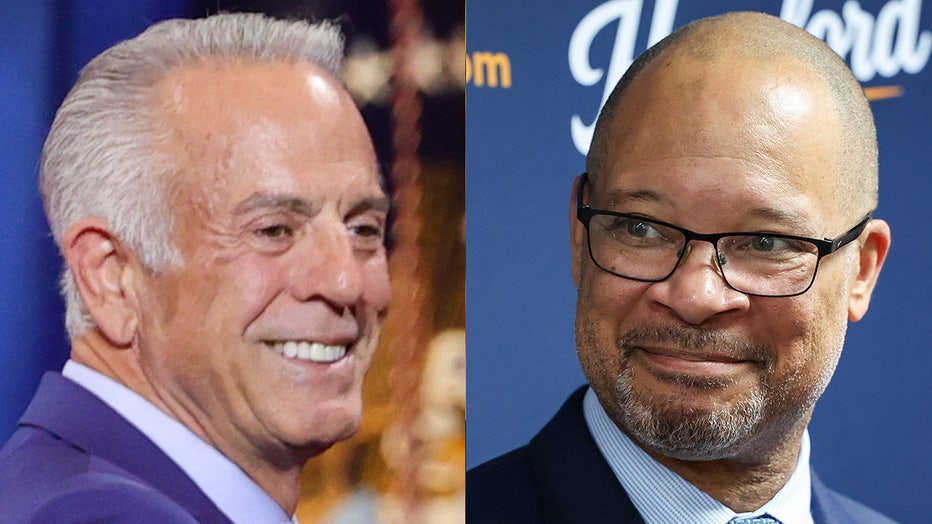
Gov. Joe Lombardo (L) and state Attorney General Aaron Ford compete in the Nevada gubernatorial race. (Photo by: Ian Maule/Bloomberg via Getty Images and Ethan Miller/Getty Images)
Nevada’s governor candidates
Joe Lombardo
In 2022, Lombardo defeated Democratic incumbent Gov. Steve Sisolak, who was running for his second term, to win the governor’s mansion. In a state dealing with one of the highest unemployment rates in the country, Lombardo is pointing to recent job growth in Nevada over the past four years as one of his key successes and says he plans to make the state more user-friendly.
Lombardo’s campaign highlighted $2 billion in new funding that was approved during the governor’s first term. On the housing front, his website touts $183 million invested for new housing and claims that, as governor, he helped streamline the home construction process. Lombardo has also held up the 160 vetoes he has issued during his four years as governor, which his campaign calls a state record, as evidence that he is protecting people and businesses.
Aaron Ford
While both U.S. Senators and three of the four House representatives are Democrats, and Ford has won statewide races in his own right, the governor’s seat has been far more elusive for the party. Ford would only be the second Democrat elected governor since the turn of the century, after Steve Sisolak, the one-term governor whom Lombardo beat in 2022.
Ford has highlighted housing and health care, among other issues, in his campaign. A former teacher and state senator, he has described an affordable housing crisis and introduced ideas like restricting some speculative purchases and easing restrictions on new construction. Ford held up his eight years as attorney general as an example of his willingness to stand up to drug companies and pledged to investigate actions by pharmacy benefit managers that he described as predatory.
Danielle Ford
The Democratic nominee is not the only Ford on Nevada’s gubernatorial ballot. State Board of Education member Danielle Ford is running as a nonpartisan candidate. The marketer and public speaker explains she is focused on systemic issues involving education, health care, public safety, and affordability, saying they are all interconnected.
Ford explained that running as a nonpartisan candidate allows her to focus on solutions without worrying about which party would get credit. A former Clark County School District trustee from Las Vegas, she pointed out that her foundation is in education, and improving that is the first key to her systems-repair philosophy.
Ohio's governor race
The once famously purple Buckeye State has turned solidly Republican in recent election cycles, particularly since President Donald Trump arrived on the political scene. Currently, the GOP has locked down both chambers of the state legislature, all statewide elected offices, and both U.S. Senate seats.
Democrats have not won a gubernatorial race in Ohio in 20 years, but the party is hoping that growing voter dissatisfaction will give nominee Amy Acton the opening she needs to break its losing streak. To do so, though, she must defeat onetime GOP presidential candidate Vivek Ramaswamy, the billionaire Republican nominee who has already picked up President Donald Trump’s active support.
For both candidates, a key route to the governor’s mansion in Columbus is going to take them through the backroads of the often ruby-red parts of Ohio. As rural America’s concerns about the economy grow, rural Ohioans are expressing concerns about rising prices and health care costs, the war in Iran, and data centers.
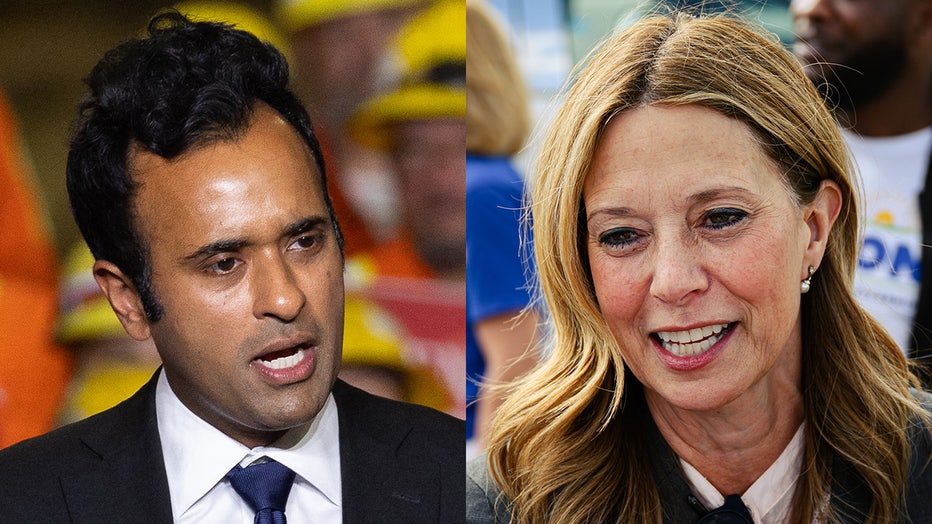
Vivek Ramaswamy (L) and Amy Acton are campaigning to be the next governor of Ohio. (Photo by Leandro Lozada / AFP via Getty Images and Jon Cherry/Getty Images)
Ohio’s governor candidates
Amy Acton
In the rural parts of the state, Acton’s campaign is looking to drive disaffected Democrats to the polling places and win over engaged, but undecided, independent voters. Acton would also like to pick off what her campaign officials call "legacy Republicans" and describe as those "disgusted with how they’ve seen their party go into the MAGAsphere."
Acton, who served as the state’s health director during the early days of the COVID-19 pandemic, wants to tap those rural voters who often live in parts of the state where Republicans consistently win elections at local, state, and federal levels, and have grown frustrated with the results. On the campaign trail, Acton has blamed the war in Iran for rising gas and fertilizer prices and decried the Trump administration’s cuts to Medicaid support for rural hospitals.
Much of Acton’s campaign has targeted the affordability message, with her signature proposals promising to cut working-class taxes, reduce utility costs, and ensure people have access to health care. She also has looked to broaden her appeal by rejecting some policy positions held by more progressive Democratic candidates, such as opposing transgender athletes competing in women’s sports and supporting local law enforcement cooperating with U.S. Immigration and Customs Enforcement.
Vivek Ramaswamy
Ramaswamy aims to take the Republican baton from the term-limited Gov. Mike DeWine, and he has already enlisted the party’s biggest name to help him do so. Trump has already visited Ohio in a bid to get Ramaswamy and GOP Senate nominee Sen. Jon Husted past the finish line.
Despite the active support from the president, the biotech entrepreneur has positioned himself as an outsider who "can’t be bought" and highlights how his family achieved the American dream after immigrating from India. To help maintain the GOP’s grip on rural voters, Ramaswamy has championed endorsements from farming groups and the National Rifle Association.
Like Acton, Ramaswamy has targeted tax cuts as a key element of his platform, promising to cut property taxes and begin working to eliminate the state income tax. As a proponent of developing domestic energy, Ramaswamy has pledged to cut electric bills by expanding natural gas, and he has been a proponent of fracking. Recently on the campaign trail, he has argued for an economic boom that will protect the state’s natural resources and its water quality.
Don Kissick
Libertarian candidate Don Kissick has taken aim at two current hot-button issues and pledged to work to combat them, describing both as creating surveillance concerns. As a candidate, Kissick called for a statewide moratorium on new data centers until new standards are adopted for future construction. He has also sought to deter the use of Flock cameras and automated license plate readers.
Wisconsin's governor race
With Gov. Tony Evers opting not to seek a third term, Milwaukee County Executive David Crowley looks to carry the Democratic flag for the party and hold on to the governor’s seat, while U.S. Rep. Tom Tiffany is hoping a victory would unite the legislature and governor’s office under the Republican banner for the next four years.
In Wisconsin, the GOP currently holds majorities in both chambers of the legislature, but it is Democrats who have the edge in key statewide offices, holding both the attorney general and secretary of state seats as well.
With weeks to go until Election Day, voting has already started in the Badger State, and absentee ballots are being returned. The top issue on voters’ minds as they mail their ballots or prepare to go to their polling places between now and November 3 is inflation and the cost of living. A Marquette University poll released at the end of September found that 45% of respondents identified that as the most important issue, more than quadrupling the next highest issue, border security.
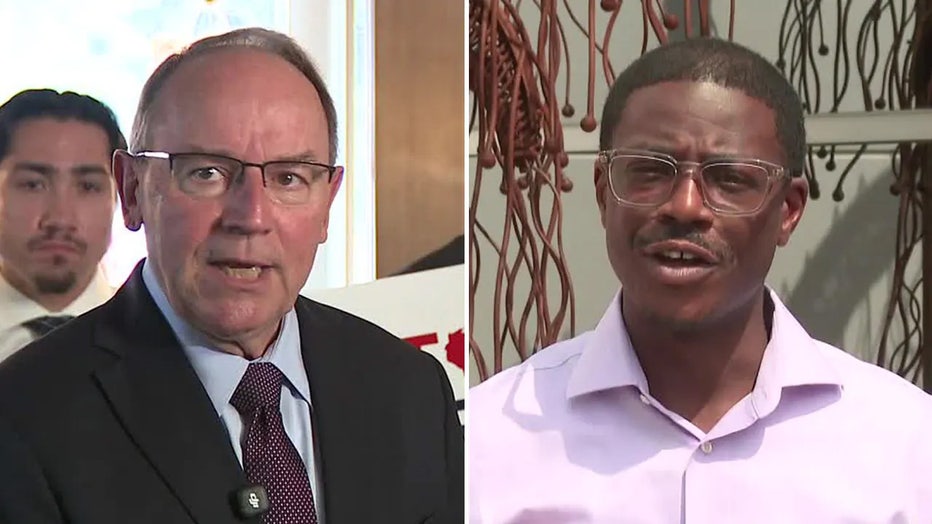
Rep. Tom Tiffany (L) and Milwaukee County Executive vie to become the next governor of Wisconsin. (WITI FOX6)
Wisconsin’s governor candidates
David Crowley
To secure the nomination, Crowley, who was considered the establishment candidate and had secured Evers’ endorsement, had to get past state Assemblymember Francesca Hong in a tight primary. Crowley positioned himself as better suited than the democratic socialist Hong to take on the Republicans in the general election.
Crowley, who would become the state’s first Black governor, has proposed allowing all residents the option to join BadgerCare, the state’s version of Medicaid, with premiums that are based on their income. It is part of a three-pronged plan that he is pitching that includes expanding housing availability, in part through greater flexibility with multi-unit homes and converting unused commercial and industrial spaces.
He also looked to target energy prices, in part by targeting data centers. In July, a poll found that approximately three-quarters of Wisconsin voters felt the costs of data centers were higher than the benefits. Crowley proposed making builders of data centers invest in grid upgrades and commit to regulations that could bring more power online before building new fossil-fuel plants.
Tom Tiffany
In a state that backed President Donald Trump in both races that he won but broke toward former President Joe Biden in 2020, Tiffany has picked up the president’s endorsement in this race. He has laid out an eight-point plan that his campaign claims will lower costs for Wisconsin residents, including a freeze on property taxes and an end to income taxes on tips and overtime.
Tiffany has criticized Crowley’s position on data centers after the Milwaukee County Executive said in the primary he opposed Hong’s proposed ban on them. At the time, Crowley said he felt that local governments should have the final say on whether they will be built and did not rule out offering tax incentives.
Tiffany, meanwhile, rejected subsidies for new data centers; however, he agreed that local governments should have the final say. The GOP nominee said it should be one of several conditions he would want before more data centers were approved.
The Source: Information for this article was taken from the Associated Press, WAGA-TV, WITI-TV, the candidates’ respective websites and campaign material, Ballotpedia, the National Governors Association, Cook Political Report, and Reuters. This story was reported from Orlando.