

Texas county accused of changing voting maps after primary elections
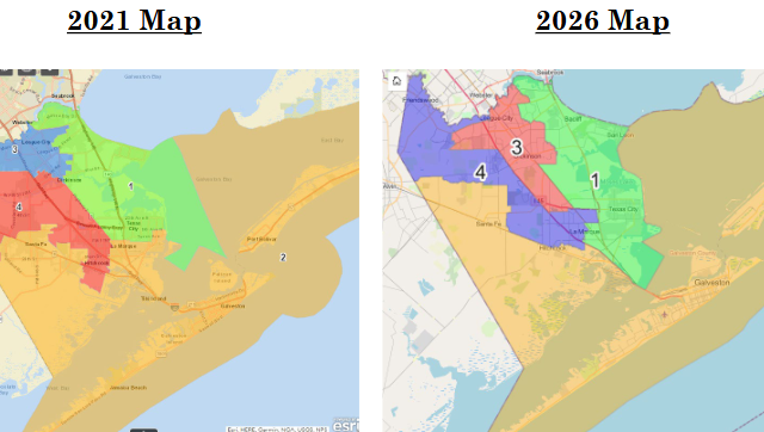
Comparison of 2021 and 2026 Galveston County precinct maps. (Campaign Legal Center)
Two voting rights groups are accusing a Texas county of a plan to change voting maps between March's primary election and November's general election.
In an emergency filing to the Texas Supreme Court, Campaign Legal Center and the UCLA Voting Rights Project claim Galveston County officials admitted to wanting to use a newly drawn map in November despite using a different map in March.
The groups claim the issue arose during a hearing in a court case challenging the county's 2021 maps. On June 30, the county filed a suggestion of mootness in the case, citing their intention to use the newly passed 2026 maps.
Those maps were passed during a June 28 commissioners court meeting. The justification for passing new maps was the commissioners' desire to divide the current boundaries and "determined that the interests of the people of the county are best served by changing the existing commissioners, constables, and justices of the peace precinct boundaries," court documents state.
At the July 28 hearing in federal court, Galveston County was asked which map they intended to use in November, because primaries for justices of the peace and commissioners had been conducted using the 2013 and 2021 maps.
When asked for clarity, attorneys for the county said they would use the 2026 maps, according to court documents.
The groups argue that such a move would cause many voters to be moved into either a new precinct with a different candidate from March or into a precinct that isn't having an election at all.
What they're saying:
"Voters who were in the precincts up for election at the time of the primary election but no longer are (as is the case for all Relators) will see their right to vote for Justice of the Peace delayed two years, resulting in a six-year period between elections. Other Galveston County voters will be able to vote for these offices after either four or even just two years as a result of the latest redistricting," court documents state.
The move, the groups argue, also prevented potential candidates from running for election in the newly drawn precincts.
Both these factors, they said, lead to a violation of the Equal Protection Clause under the Fourteenth Amendment. The petition argues the map change denied some voters the opportunity to participate, some potential candidates their opportunity to run in the primary, denied some voters who voted in the primary from voting for their candidate in November and nullified the votes cast under the old map.
The groups also argue the map switch violates the Texas Constitution and the Texas Election Code by intending to hold an election for which a primary hasn't been held.
"Election rules should not change after voters have already begun casting ballots," Bernadette Reyes, voting rights counsel at the UCLA Voting Rights Project, said. "When officials redraw districts in the middle of an election, it threatens both equal representation and confidence in our democratic process. Our lawsuit asks the court to protect those fundamental rights and principles."
They argue that without Supreme Court intervention, this tactic could be used across the state.
"Inaction from this Court in response to this Petition will greenlight them to redraw their maps prior to November, thwarting the voices of voters—perhaps in a perpetual "post-primary" redistricting scheme," the petition states.
The groups argue that allowing the maps to change opens a new path for elected officials to undermine voters and meddle in their own races.
"If polling against their general election opponent is looking bad, they can just change the map—up to the very eve of the election—to evade the voters’ judgment," the petition states.
The groups are asking for the court to block the implementation of the new maps for the November election.
The Source: Information in this article comes from documents filed in the Texas Supreme Court.