

US attacks Iran: Will gas prices go up?
U.S.-Israeli strikes on Iran could rattle global markets, pushing oil and other energy prices up if the conflict continues for a prolonged period.
The attacks against Iran began overnight after weeks of warning from the U.S. about Iran's nuclear weapons program and clashes between protesters and the country’s government. Click here for the latest updates.
MORE: Live updates: US strikes Iran amid nuclear program tensions
Oil prices have already risen on fears of war. Here’s what that could mean for gas prices:
Will gas prices go up?
Why you should care:
U.S. gas prices averaged $2.98 per gallon last week, according to U.S. motor club AAA. A wider war involving Iranian disruption of tanker traffic could see crude push past $90 per barrel and US gas prices "well above" $3 per gallon, according to Clayton Seigle at the Center for Strategic & International Studies.
RELATED: Read Trump's full statement on Iran strikes: 'We can’t take it anymore'
By the numbers:
International benchmark Brent crude closed at a seven-month high of $72.87 on Friday amid worries of a larger conflict.
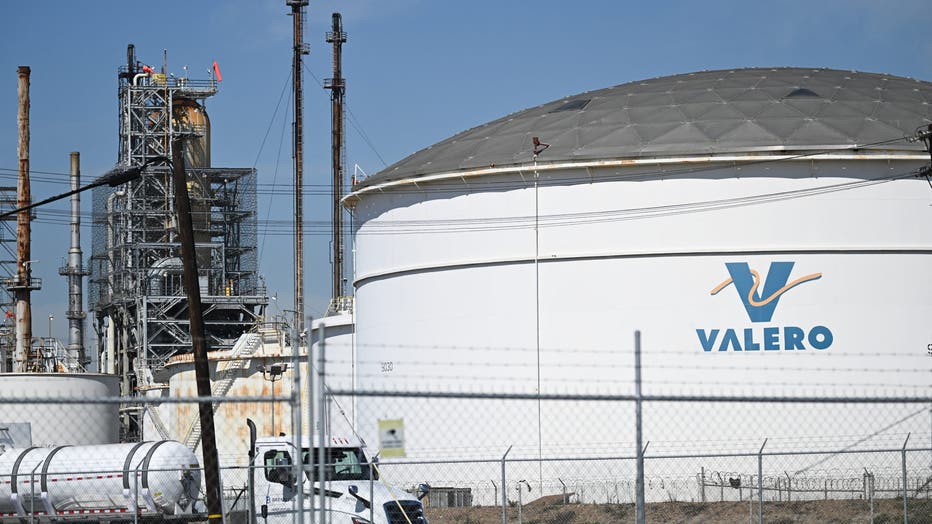
FILE - The Valero Wilmington Oil Refinery adjacent to the ports of Long Beach and Los Angeles in the Wilmington neighborhood of Los Angeles, California on April 10, 2025. Experts say a prolonged war against Iran will lead to higher gas prices here at
Limited strikes on Iran’s nuclear program and the Revolutionary Guard that avoid regime change or all-out war could see crude prices jump $5-$10 a barrel based on fear alone, according to Rystad Energy.
Iran oil exports
Big picture view:
Iran exports roughly 1.6 million barrels of oil a day, with most of it going to China because U.S. sanctions prevent Iran from selling it elsewhere. If Iran’s oil exports to China are disrupted, it could force privately owned Chinese refineries to look for oil in other places, potentially driving up prices.

Israel releases video of strikes in Iran
The IDF released footage of the US and Israel's joint attack in Iran Saturday. LiveNOW's Josh Breslow discusses the latest developments in the Middle East with the FDD's Enia Krivine.
Strait of Hormuz
Dig deeper:
Reuters reports that Iran has reportedly closed the critical Strait of Hormuz, where more than 20% of global oil supply passes through each day.
RELATED: Lawmakers react to 'Operation Epic Fury' US - Israel military strikes across Iran
If the strait remains closed Sunday evening, when oil starts trading again, the negative impact on crude could be more widespread – and that impact could extend to other energy exports, according to Barron’s.

U.S. & Israel launch military strikes on Iran
U.S. & Israel launched military strikes on Iran. U.S. official say the strikes will last days, not hours. University of Michigan's Javed Ali joins LiveNOW from FOX to discuss the latest.
Middle East exporters including Saudi Arabia, Iraq and the United Arab Emirates send most of their exports through the strait. A third of total worldwide oil exports transported by sea passed through the strait in 2025. The strait also transports 23% of the world’s liquified natural gas (LNG) and 31% of liquified petroleum gas and naphtha, according to OPIS data compiled by Barron’s.
Analysts said Iran had no incentive to close the strait because it could cut off its own exports, but that hasn’t yet deterred Iran’s leaders.
The Source: This article includes information from Barron’s, The Associated Press and previous FOX Local reporting.