

20 years ago, the National Weather Service issued its most chilling warning ever

20 years later: A look back at Hurricane Katrina
LiveNOW’s Andy Mac interviews Louisiana State University physician, Dr. Matthew Giglia to reflect on Hurricane Katrina as tomorrow marks the 20th anniversary of the deadly storm.
On August 28, 2005, an urgent and ominous weather message was sent out by the National Weather Service calling Katrina "a most powerful hurricane with unprecedented strength."
The aftermath of Hurricane Katrina has left lasting and devastating impacts on New Orleans, the state of Louisiana and surrounding areas.
The message
What they're saying:
The message was sent out by NWS at approximately 10:11 a.m. CT the day before Katrina hit the United States.
"...DEVASTATING DAMAGE EXPECTED...HURRICANE KATRINA...A MOST POWERFUL HURRICANE WITH UNPRECEDENTED STRENGTH...RIVALING THE INTENSITY OF HURRICANE CAMILLE OF 1969.
MOST OF THE AREA WILL BE UNINHABITABLE FOR WEEKS...PERHAPS LONGER. AT LEAST ONE HALF OF WELL CONSTRUCTED HOMES WILL HAVE ROOF AND WALL FAILURE. ALL GABLED ROOFS WILL FAIL...LEAVING THOSE HOMES SEVERELY DAMAGED OR DESTROYED.
THE MAJORITY OF INDUSTRIAL BUILDINGS WILL BECOME NON FUNCTIONAL. PARTIAL TO COMPLETE WALL AND ROOF FAILURE IS EXPECTED. ALL WOOD FRAMED LOW RISING APARTMENT BUILDINGS WILL BE DESTROYED. CONCRETE BLOCK LOW RISE APARTMENTS WILL SUSTAIN MAJOR DAMAGE...INCLUDING SOME WALL AND ROOF FAILURE. HIGH RISE OFFICE AND APARTMENT BUILDINGS WILL SWAY DANGEROUSLY...A FEW TO THE POINT OF TOTAL COLLAPSE. ALL WINDOWS WILL BLOW OUT.
AIRBORNE DEBRIS WILL BE WIDESPREAD...AND MAY INCLUDE HEAVY ITEMS SUCH AS HOUSEHOLD APPLIANCES AND EVEN LIGHT VEHICLES. SPORT UTILITY VEHICLES AND LIGHT TRUCKS WILL BE MOVED. THE BLOWN DEBRIS WILL CREATE ADDITIONAL DESTRUCTION.
PERSONS...PETS...AND LIVESTOCK EXPOSED TO THE WINDS WILL FACE CERTAIN DEATH IF STRUCK. POWER OUTAGES WILL LAST FOR WEEKS...AS MOST POWER POLES WILL BE DOWN AND TRANSFORMERS DESTROYED. WATER SHORTAGES WILL MAKE HUMAN SUFFERING INCREDIBLE BY MODERN STANDARDS.
THE VAST MAJORITY OF NATIVE TREES WILL BE SNAPPED OR UPROOTED. ONLY THE HEARTIEST WILL REMAIN STANDING...BUT BE TOTALLY DEFOLIATED. FEW CROPS WILL REMAIN. LIVESTOCK LEFT EXPOSED TO THE WINDS WILL BE KILLED. AN INLAND HURRICANE WIND WARNING IS ISSUED WHEN SUSTAINED WINDS NEAR HURRICANE FORCE...OR FREQUENT GUSTS AT OR ABOVE HURRICANE FORCE...ARE CERTAIN WITHIN THE NEXT 12 TO 24 HOURS. ONCE TROPICAL STORM AND HURRICANE FORCE WINDS ONSET...DO NOT VENTURE OUTSIDE!"
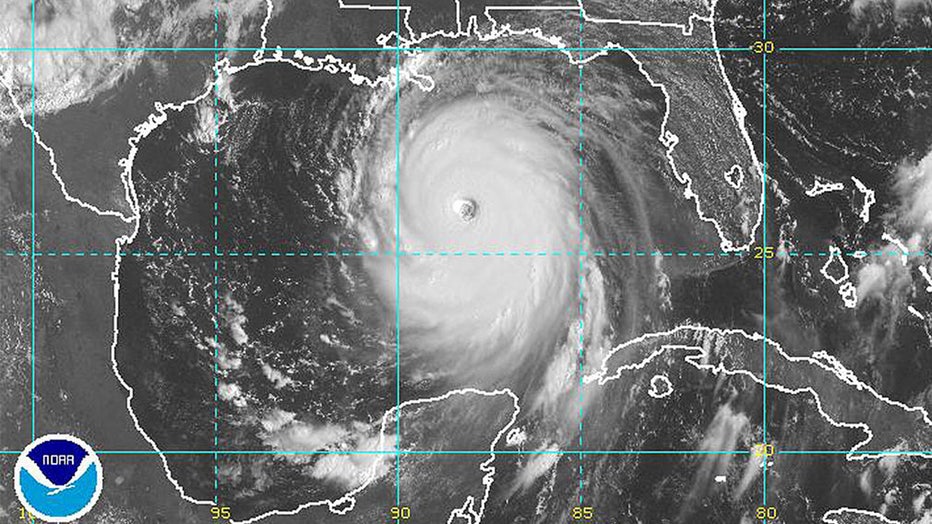
FILE - In this visible satellite image from NOAA, Hurricane Katrina is seen in the Gulf of Mexico August 28, 2005. (Photo by NOAA via Getty Images)
Hurricane Katrina
Timeline:
The storm first developed on August 23, 2005, as a tropical depression over the southeastern Bahamas and, within a day, strengthened into Tropical Storm Katrina before moving toward Florida.
Due to the warm waters of the Gulf Stream, Katrina quickly organized and made landfall near the Miami-Dade and Broward County line as a Category 1 hurricane with winds of 80 mph.
The storm did not lose steam over the Florida Peninsula and, once over the warm waters of the Gulf of Mexico, it exploded.
Within 72 hours, Katrina became a Category 5 hurricane with peak sustained winds of 175 mph.
Equally impressive was its size, with NOAA estimating Katrina was nearly 800 miles wide and covered much of the Gulf.
It came onshore at 6:10 a.m. local time on Aug. 29, 2005, near the mouth of the Mississippi River near Buras, Louisiana.
By the numbers:
Damage was initially estimated at $108 billion, making Katrina the costliest hurricane in U.S. history at the time, surpassing 1992’s Hurricane Andrew.
Adjusted for inflation, NOAA estimated the 2024 value of damage caused by the storm to be north of $201 billion.
Katrina is also the fifth-deadliest natural disaster, responsible for 1,833 fatalities, according to the NWS.
In light of the destruction and lost lives, the World Meteorological Organization retired the name Katrina in April 2006, replacing it with Katia, which was used to name storms in 2011, 2017, 2023 and is on deck to be used again in 2029.
The Source: Information for this article was taken from the National Weather Service website, previous reporting by The Associated Press and FOX News. FOX Weather also contributed.