

Northern lights may be visible in the US this week: Here's where

How to survive a coronal mass ejection
Most of Earth's modern power grids are more than capable of handling a large solar flare or coronal mass ejection but, what if a particularly strong space weather event took place?
You could catch a glimpse of the northern lights this week – if you’re in the optimal location.
Over the last 24 hours, the sun has emitted several powerful solar flares, including one X-class flare (the most powerful category of solar flares), two M-class flares (moderate) and 25 common solar flares.
The sun is particularly active right now and that means there’s a great chance to enjoy some northern lights, if you know where to look.
Here’s where you can catch this celestial event:
Northern lights visible in parts of US
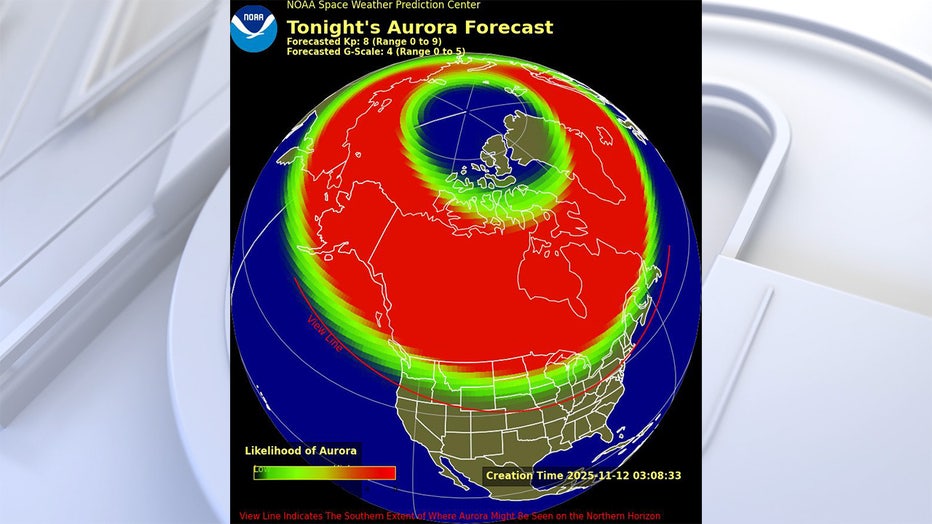
Aurora borealis forecast for Nov. 11, 2025. (Credit: NOAA Space Weather Prediction Center)
Local perspective:
With compounding coronal mass ejections making their way towards Earth, it is very possible for people living in the northern part of the United States to see some stellar auroras Nov. 11, Nov. 12 and Nov. 13, according to the NOAA’s Space Weather Prediction Center.
Twenty-one states have the potential to see northern lights in the coming days, including:
Northern lights could also be seen as far south as Alabama and northern California on Nov. 12, according to the NOAA, but this is dependent upon the orientation of Earth’s magnetic field.
The best times to see northern lights in the US
Dig deeper:
The NOAA said the best times to potentially see northern lights from the U.S. are:
- 4 p.m. to 10 p.m. ET
- 10 p.m. - 1 a.m. ET
A geomagnetic storm watch was issued by the NOAA on Tuesday, with predicted storm categories reaching strong and severe.
- Nov 12: G4 (severe) category storm
- Nov. 13: G3 (strong) category storm
- Nov. 14: G1 (minor) category storm
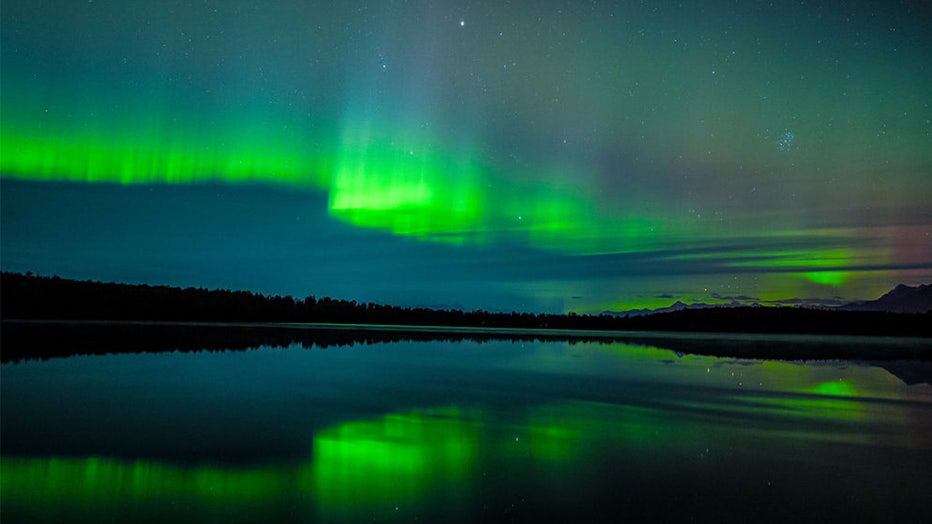
FILE - Northern lights (Aurora Borealis) illuminate the sky over Beach Lake in Alaska's Chugiak region, United States on the night of Sept.28th to 29th, 2025. (Photo by Hasan Akbas /Anadolu via Getty Images)
What you can do:
Tips on seeing northern lights:
- Try to find an unobscured view and look toward the northern horizon.
- It must be dark outside, so if you can, go somewhere that has as little light pollution as possible.
- The best time to see auroras is within an hour or two of midnight, according to the NOAA.
- Check the weather forecast because clouds can cover up the spectacle entirely.
- Taking a picture with a smartphone camera may also reveal hints of the aurora that aren’t visible to the naked eye.
The Source: Information for this article was taken from the NOAA’s Space Weather Prediction Center website and reporting by Accuweather and Space.com. Previous reporting by FOX Local also contributed to this report. This story was reported from San Jose.