

Saturn’s south pole has a giant 10-sided cloud mystery, scientists say
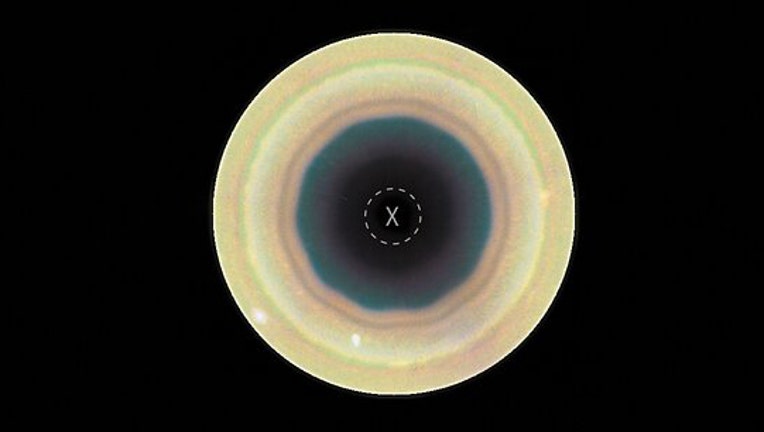
Image Credit: NASA, ESA, STScI, A. Sánchez-Lavega (University of the Basque Country), A. Simon (NASA-GSFC), M. Wong (UC Berkeley); Image Processing: A. Pagan (STScI)
Scientists have identified a massive, 10-sided wave pattern swirling through the icy ammonia clouds above Saturn’s south pole.
Dig deeper:
The spinning, meandering formation appears larger and less stable than the planet’s famous north-pole hexagon, which was first observed by NASA’s twin Voyagers in the 1980s, according to a Spanish-led research team.
The jet stream formation was spotted by the Hubble Space Telescope in 2023 after earlier observations failed to detect it. Researchers believe it may have formed between 2017 and 2023, when Saturn’s south pole was tilted away from Earth and out of view.
RELATED: September skywatching guide: Harvest Moon, bright Venus, fall equinox and more ahead
The decagon may still be evolving, with each side already stretching more than 10,000 miles.
NASA holds news conference after space telescope launch
NASA officials on Sunday held a press conference after the launch of the Nancy Grace Roman Space Telescope.
The discovery suggests "the ‘unique’ hexagon is not as extraordinary as we thought," lead author Agustin Sanchez-Lavega of the University of the Basque Country said in an email.
The findings were published in the journal Science Advances.
Although all of the solar system’s planets with atmospheres have wave-spawning disturbances, only Saturn churns them out looking like polygons, geometric shapes bounded by straight lines.
RELATED: President Trump awards Artemis II crew Congressional Space Medal of Honor
Both sit on jet streams, but the hexagon is practically stationary whereas the decagon migrates eastward at a tame 6 mph (10 kph).
What they're saying:
"Saturn still has the ability to surprise us," the University of Leicester's Leigh Fletcher said in a statement. He measured the wind in the decagon as part of the study using the European Southern Observatory's Very Large Telescope in Chile.
By comparing these two formations on opposite ends of Saturn, scientists can learn more about the weather patterns of giant gas planets, according to Sanchez-Lavega.
"This is a highly interesting phenomenon that appears to be unique to Saturn, and we want to know why," he said.
Big picture view:
Sanchez-Lavega wonders whether they might be related to the cyclones on Jupiter that are arranged in polygonal shapes. Improving views of Saturn's southern hemisphere over the next several years should allow astronomers to capture more details of the decagon and perhaps solve "this intriguing atmospheric mystery," he said.
It’s unclear whether the decagon will last as long as the hexagon, which has been visible by spacecraft for more than 40 years. That is longer than a Saturnian year, which is equivalent to 30 Earth years.
"For the time being, all I can confirm is that the decagon is still there," Sanchez-Lavega said.
The Source: The Associated Press contributed to this report. The information came from a Spanish-led research team’s findings, which were published in the journal Science Advances. This story was reported from Los Angeles.
___