

Supreme Court rules against law banning 'conversion therapy' for LGBTQ+ kids
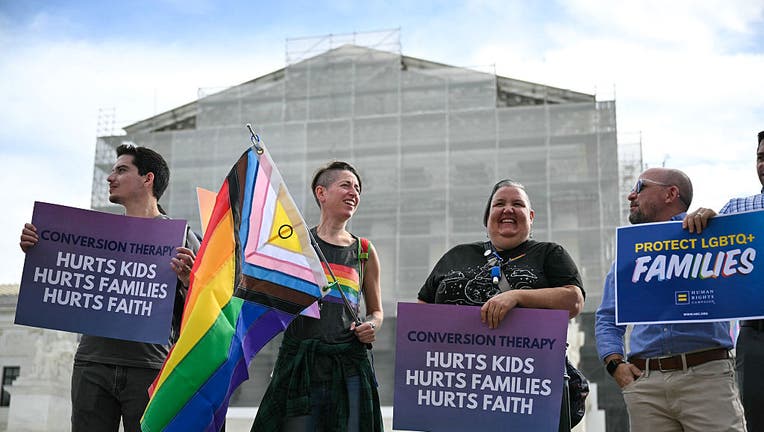
Demonstrators protest against conversion therapy outside the US Supreme Court as the Court hears oral arguements in Chiles v. Salazar, a landmark case on conversion therapy, on October 7, 2025, in Washington, DC. (Photo by ANDREW CABALLERO-REYNOLDS /
WASHINGTON - The Supreme Court on Tuesday ruled against a law banning "conversion therapy" for LGBTQ+ kids in Colorado, one of about two dozen states that banned the discredited practice.
In an 8-1 decision, the majority sided with a Christian counselor who argues the law banning talk therapy violates the First Amendment. The justices agreed that the law raises free speech concerns and sent it back to a lower court to decide if it meets a legal standard that few laws pass.
The ruling is the latest in a line of recent cases in which the justices have backed claims of religious discrimination while taking a skeptical view of LGBTQ rights.
What they're saying:
Justice Neil Gorsuch, writing for the court, said the law "censors speech based on viewpoint." The First Amendment, he wrote, "stands as a shield against any effort to enforce orthodoxy in thought or speech in this country."
Gorsuch's opinion drew support from liberal Justices Elena Kagan and Sonia Sotomayor.
A state could similarly not ban talk therapy designed to affirm a minor’s sexual orientation or gender identity, Kagan wrote. "Once again, because the State has suppressed one side of a debate, while aiding the other, the constitutional issue is straightforward," she wrote.
In a solo dissent, Justice Ketanji Brown Jackson wrote that states should be free to regulate health care, even if that means incidental restrictions on speech. The decision, Jackson wrote, "opens a dangerous can of worms" that "threatens to impair states' ability to regulate the provision of medical care in any respect."
What is "conversion therapy"?
Dig deeper:
So-called "conversion therapy" is the scientifically discredited practice of using therapy to "convert" LGBTQ people to heterosexuality or traditional gender expectations.
RELATED: Support for same-sex marriage stays strong as party divide widens, poll shows
The practice has been banned in 20 states and in more than a dozen communities across Wisconsin. Since April 2024, the Wisconsin professional licensing board for therapists, counselors and social workers has labeled "conversion therapy" as unprofessional conduct.

Supreme Court weighs case on conversion therapy
The Supreme Court is hearing arguments on a case involving conversion therapy. Legal Analyst Neama Rahmani joins LiveNOW from FOX with an update on the latest.
Advocates seeking to ban the practice want to forbid mental health professionals in the state from counseling clients with the goal of changing their sexual orientation or gender identity.
How did the Supreme Court get the case?
The backstory:
Kaley Chiles, with support from President Donald Trump’s administration, argued that the laws, passed by about half of U.S. states, wrongly barred her from offering voluntary, faith-based "conversion" therapy for kids.
She’s challenged the law in Colorado. The state says its measure simply regulates licensed therapists by barring a practice that’s been scientifically discredited and linked to serious harm.
RELATED: Trump signs order aiming to limit gender transitions for minors
During arguments, the court’s conservative majority didn’t seem convinced that states can restrict talk therapy aimed at changing feelings or behavior while allowing counseling that affirms kids identifying as gay or transgender. Justice Samuel Alito said the law "looks like blatant viewpoint discrimination."

?Please forgive me?: Former conversion therapy leader comes out as gay, apologizes
McKrae Game, a conversion therapy leader for two decades, came out as gay in June and is asking for forgiveness for the harm he said he caused.
What they're saying:
Chiles contends her approach is different from the kind of conversion therapy once associated with practices like shock therapy decades ago. She said she believes "people flourish when they live consistently with God’s design, including their biological sex."
RELATED: Idaho drag performer awarded $1.1 million in defamation suit against far-right blogger
Her attorneys argue the bans make it difficult for parents to find a therapist willing to work on gender identity unless the counseling specifically affirms transition.
The other side:
Families who have spoken in favor of restrictions include Linda Robertson, a Christian mom of four from Washington state whose son Ryan underwent therapy that promised to change his sexual orientation after he came out to her at age 12. The techniques led him to blame himself when it didn’t work, leaving him ashamed and depressed, she said. He died in 2009, after multiple suicide attempts and a drug overdose at age 20.
Colorado argued its law does allow for wide-ranging faith-based conversations, and it exempts religious ministries. No one has been sanctioned under the 2019 law.
The Source: The Associated Press contributed to this report. This story was reported from Los Angeles.