

Texas flooding: List of resources for victims affected by Central Texas floods

Texas floods: List of resources for Texans
Governor Greg Abbott announced the federal government had moved forward with his request to extend federal assistance.
TEXAS - Governor Greg Abbott announced the federal government had moved forward with his request to extend federal assistance.
Five additional counties were added to the President’s disaster declaration at the request of Governor Abbott.

Texas flooding: Gov. Abbott speaks on Central Texas damage, recovery
As of July 14, Gov. Abbott announced 131 people are dead after devastating flooding in Central Texas.
Abbott speaks on flooding damage
What they're saying:
"We are pushing forward to help those whose homes and businesses have been impacted through the FEMA Individual Assistance Program," said Nim Kidd, Chief of the Texas Division of Emergency Management.
President Trump's Major Disaster Declaration now incorporates Burnet, Llano, Mason, McCulloch, Tom Green, Williamson, Coke, and Concho counties.
"One thing that is speeding that recovery was the immediate granting of the major master declaration that was granted by President Trump," said Governor Abbott.

Texas floods: Abbott speaks on damage & recovery
Gov. Abbott spoke about the heartache people are still feeling and how the weather continues to hamper response efforts in Central Texas and in Kerr County. He also spoke about how 25 different states have sent teams to Texas to help with the response
Governor Abbott said these areas exceed the criteria for FEMA’s program, which covers assistance for emergency work and repairing damaged facilities. Other counties that have qualified include Williamson, Travis, Kendall, Kerr, Kimble, Menard, and San Saba.
"It immediately opened not only access to more funding, but also access to more resources to be able to more quickly and more effectively respond to this storm," said Governor Abbott.
"Please, if you have not submitted into the ISTAT program yet and your home or business was impacted, you send that information to us," said Kidd.
Resources for impacted Central Texans

Texas flooding: Resources for those impacted
Many businesses and organizations are providing resources for those impacted by the devastating and deadly flooding from over the weekend.
FEMA
For anyone seeking federal assistance from the flooding, the Texas Department of Emergency Management is directing people to use the Individual State of Texas Assessment Tool (iSTAT) by visiting damage.tdem.texas.gov or by calling 800-621-3362.
Texans who sustain damage to homes and businesses as a result of severe storms and flooding are encouraged to report their damages using iSTAT.
Reporting damage information through the online survey helps officials connect impacted Texans with resources and services.
Additionally, once those damages are reported to the state, officials can determine whether they meet the federally-set thresholds for federal disaster assistance.
American Red Cross
The American Red Cross is providing numerous support services for people who the natural disaster has impacted.
The Flood Resource Center offers several services, such as hot showers, meals, health screenings, and charging stations.
If you or someone you know has been impacted by recent flooding, the American Red Cross is providing support services. Call 1-800-RED-CROSS (1-800-733-2767) to request emergency assistance.
Disaster Unemployment Assistance (DUA)
Gov. Greg Abbott announced the Texas Workforce Commission (TWC) is accepting applications for Disaster Unemployment Assistance (DUA) for several Central Texas counties.
Workers and self-employed people in Burnet, San Saba, Tom Green, Travis, and Williamson counties who have been unable to work due to damage from devastating flooding may be eligible for DUA benefits.
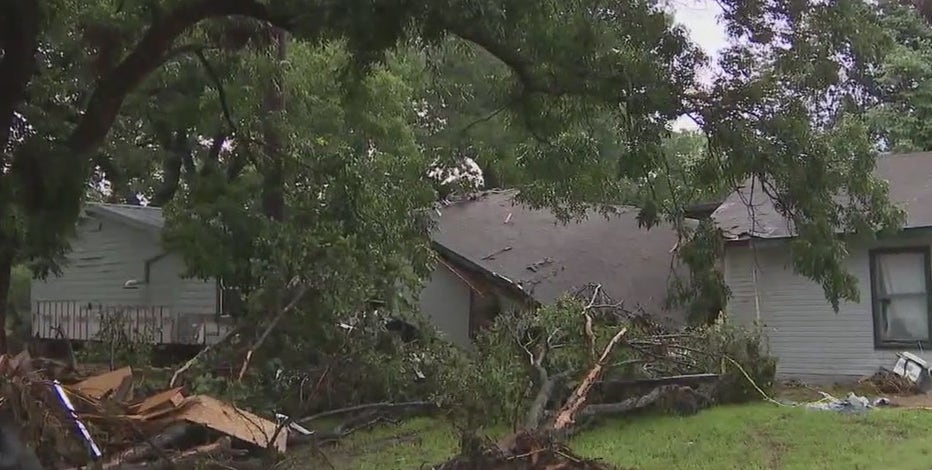
Texas flooding: More Central Texas counties added to Trump's Major Disaster Declaration
Five Central Texas counties were added to President Trump's Major Disaster Declaration.
If you were affected by flooding and are in the five designated counties, you can apply for benefits online through Unemployment Benefit Services or by calling TWC at (800) 939-6631 between 8 a.m. and 6 p.m. Monday through Friday.
Applications for DUA benefits under this declaration must be submitted by September 4, 2025.
Applicants should also specify that their applications are related to the damage caused by Hill Country flooding.
Burnet County's MARC
Burnet County established the multi-agency resource center (MARC).
"Here we have the ARC, the American Red Cross, Blue Monarch Trails Community Resource Center, to name a few," said Derek Marchio, Emergency Management Coordinator for the Burnet County Office of Emergency Management.
Several organizations are meeting the needs of the people in one place at the community center.
"Cleaning up their homes and their properties, fixing fences, and also assisting with things like temporary housing, basically a full gamut of resources are available here in Burnett County," said Marchio.
Marchio said he had close to 60 people come in on Monday for help.
The MARC will open at the Burnet Community Center, at 401 E. Jackson Street, in Burnet. It will remain open from 7 a.m. to 7 p.m. until Friday, July 18.
For anyone needing assistance, visit their website. Click on the "GET HELP" button on the homepage to fill out a form. Afterward, their team will follow up as soon as they can.
For more flood-related resources, click here.
Travis County Cares Fund
The Travis County Cares Fund was established Tuesday through a formal agreement between Commissioners Court and the Central Texas Community Foundation (CTXCF).
The fund is meant to be a short-term disaster relief fund aimed at supporting local residents impacted by the Independence Day holiday weekend flooding.
CTXCF will administer the fund, receiving and processing contributions and working closely with the County to ensure timely, equitable distribution of financial assistance to affected individuals and families.
The Travis County Cares Fund is designed to provide direct financial relief to residents whose homes or lives were significantly impacted by the July 5 flood disaster. Under the MOU, CTXCF will manage the fund, maintain donor records, and oversee disbursements based on eligibility guidelines developed in collaboration with Travis County.
To ensure transparency and accountability, the County will provide disaster impact data, appoint a liaison to work with CTXCF staff, and help shape fair and effective distribution criteria.
Contributions to the Travis County Cares Fund will be tax-deductible and used exclusively for relief within Travis County. A standard 5% administrative fee will apply to donations, along with minimal credit card processing fees, as needed.
Those interested in contributing or learning more about the Travis County Cares Fund can go here.
The Source: Information from interviews conducted by FOX 7 Austin's Katie Pratt and previous coverage