

UT Austin researchers compete in autonomous wildfire-fighting competition

UT researchers test firefighting drone
A group of researchers at UT Austin are in an international competition to detect and put out wildfires before they become destructive. FOX 7 Austin's Angela Shen reports.
AUSTIN, Texas - A group of researchers at the University of Texas at Austin is leading a team that's taking part in an international competition to detect and put out wildfires before they become destructive.
What we know:
The FLARE-X team is made up of researchers from UT Austin, University of Southampton, University of Edinburgh, and the Texas A&M Forest Service.
They're one of 15 semi-finalists in the XPRIZE Wildfire Competition.
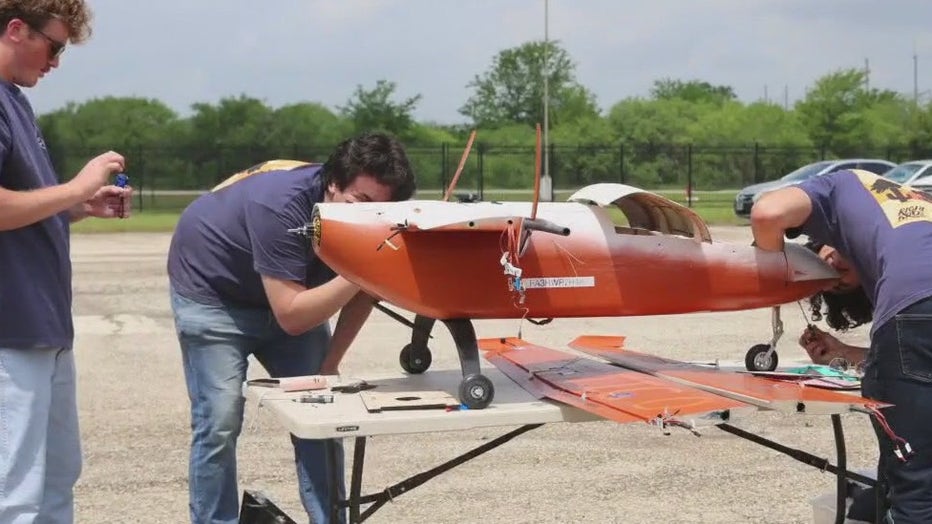
The FLARE-X team came up with two uncrewed aerial aircraft, which are essentially large drones. The first one is for detection while the second is for suppression.
Thet FLARE-X team started developing ideas in 2023. In the coming months they'll do field-testing. They hope to make it to the finals, with the goal of using the tools in the real world.
What they're saying:
"Wildfires aren't just impacting populations here at home, but they're impacting people across the world," Dr. James Thompson, research assistant professor in the Bureau of Economic Geology said.
"We have a bunch of visible near-infrared and thermal sensors that are designed to rapidly detect thermal anomalies that are associated with something burning," Thompson added. "We've also got to be careful not to detect someone who's maybe just grilling outside their backyard."
The drones can cover a wide area. Thompson says two could cover all of Austin.
"We can surveil the area very quickly and very rapidly to be able to find those wildfires before they become disastrous and cause a lot of damage to both people and property," Thompson said.
"We hope to then also provide this, provide our solution as a service to fire departments, both in Austin, across the state of Texas, across the U.S. and the continent and also globally," Thompson said.
What is the XPRIZE Wildfire competition?
Big picture view:
It's a four-year, $11 million competition where teams develop autonomous systems to fight wildfires within minutes of them starting.
The system has to:
- Detect, assess and suppress an incipient-stage, high-risk wildfire
- Operate fully autonomously with no human intervention
- Do so in under 10 minutes, across a 1,000-square-km area
- Ignore low-risk fires
To learn more about the competition, click here.
The Source: Information in this report comes from interviews and reporting by FOX 7 Austin's Angela Shen.