

DOJ sues to block new California congressional map following Prop 50 win
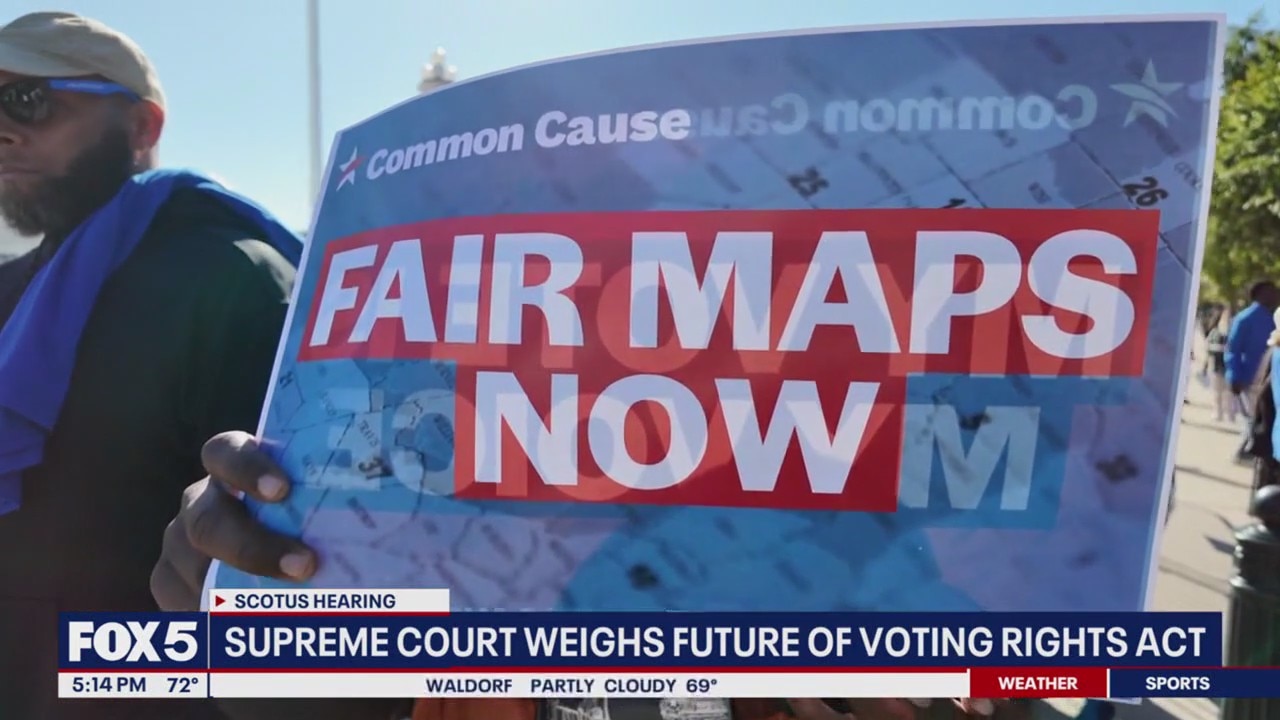
Supreme Court weighs future of Voting Rights Act
The Supreme Court is considering whether to once again limit the Voting Rights Act. The case comes out of Louisiana, but the court's decision could affect every state and potentially the balance of Congress ahead of the 2026 midterms. FOX 5’s Katie Barlow was in the courtroom.
WASHINGTON - The Department of Justice (DOJ) on Thursday filed a motion to aid in a lawsuit California Republicans have brought against Gov. Gavin Newsom over Prop 50, which California voters passed on Nov. 4, according to POLITICO.
The backstory:
Proposition 50, introduced by Newsom, authorizes California lawmakers to redraw the state's congressional districts, which could in turn deliver several new Democratic seats in the House.
U.S. Attorney General Pam Bondi accused the California governor of committing a "brazen power grab that tramples on civil rights and mocks the democratic process," in a statement on Thursday.
"Governor Newsom’s attempt to entrench one-party rule and silence millions of Californians will not stand," she said.
After polls closed on Election Day, California Republicans brought the lawsuit against Newsom and California Secretary of State Shirley Weber; they claim that Prop 50 violates the U.S. Constitution, specifically the 14th and 15th amendments.
DOJ lawyers concur – they argue that because California Democrats considered the number of Latino voters in each new district under Prop 50, the amendment allows for racial gerrymandering, as POLITICO notes.
"Race cannot be used as a proxy to advance political interests, but that is precisely what the California General Assembly did with Prop 50," Deputy Assistant Attorney General for Civil Rights Jesus Osete said in a statement Thursday.
Newsom and Trump go head-to-head
Dig deeper:
Newsom introduced Prop 50 in response to President Donald Trump urging GOP-controlled states, such as Texas, to redraw their district lines to ensure that the Republican Party retains its current majority in the House of Representatives once the 2026 midterm elections roll around.
The governor's theory is that Prop 50 gives Democrats a chance at grabbing as many as five additional Congressional seats, which would be just enough to compete with the up to five seats Texas Republicans' could win due to Trump's intervention, as noted by The Associated Press.
The debacle between the two states has set off a chain reaction across the nation – congressional redistricting efforts such as these have popped up in Missouri, North Carolina, Utah, Louisiana, Ohio, Virginia, Maryland and Indiana.
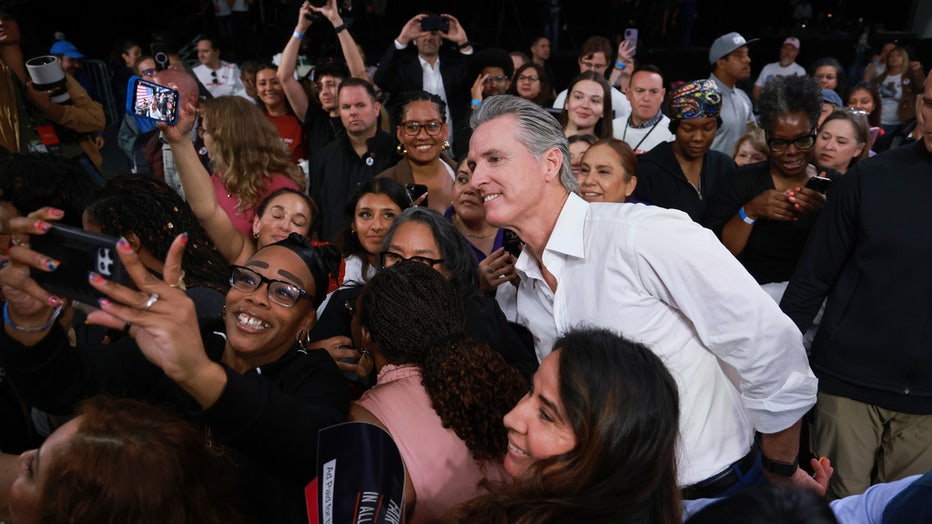
Gov. Gavin Newsom meets with attendees during a campaign event on Proposition 50, Saturday, Nov. 1, 2025, in Los Angeles. (AP Photo/Ethan Swope)
SCOTUS and The Voting Rights Act
Big picture view:
The fight over Prop 50 comes as the U.S. Supreme Court appears inclined to limit the Voting Rights Act's ability to force states to draw electoral districts in favor of minority voters.
Section 2 of the Voting Rights Act specifically prohibits voting practices and procedures that discriminate on the basis of race; if it were to be done away with, the main way plaintiffs challenge discriminatory election practices would cease to be.
The plaintiffs in a case that the U.S. Supreme Court began hearing arguments over last month claim that a Black-majority congressional district in Louisiana relies too heavily on race, and therefore has an unconstitutional racial basis.
If the court does in fact strike down the provision, it would represent a significant shift in the landmark law, which was passed in 1965 as a means of undoing "the political hold of Jim Crow policies in the South and related discriminatory structures nationwide," according to the Brennan Center for Justice.
Such a ruling would make it much more difficult to take race into account when drawing congressional maps. This would, according to the AP, help boost Republican electoral prospects by eliminating Black and Latino districts, which tend to skew Democratic. It would also mean that states would not be bound by any limits in how they draw electoral districts, which would lead to even more extreme partisan gerrymandering.
The Source: Information above was sourced from a DOJ motion, The Associated Press, POLITICO, The Guardian, the U.S. Department of Justice, the California Legislative Analyst's Office, The Sacramento Bee, the National Archives, the Brennan Center for Justice, Pew Research Center and previous FOX 5 DC reporting.