

Here's how much warmer your winter has gotten since 1970

See how your state ranks against the coldest temperatures in US history
Check out some of the most interesting and notable record-low temperatures around the country.
Winter is warming faster than other seasons across much of the U.S., with nearly every major city experiencing higher average temperatures and more unusually warm days than it did decades ago, according to a new analysis.
Climate Central analyzed 244 major U.S. cities using temperature data from the National Oceanic and Atmospheric Administration (NOAA) and Climate Central's Climate Shift Index (CSI) to examine winter temperature trends from 1970 to 2026.
Winter temperature increased in 99% of cities analyzed
Big picture view:
The data found that average winter temperatures increased in 99% of the analyzed cities since 1970.
Across the 242 cities that experienced warming, winter temperatures rose by an average of 3.9 degrees Fahrenheit.
The warming trend was also reflected in the number of winter days with temperatures above historical averages.
Since 1970, 98% of the cities analyzed experienced an increase in warmer-than-normal winter days, with an average of 13 additional days. Nearly nine in 10 cities now experience at least seven more such days than they did in the early 1970s.
Midwest, Northeast see most winter warming
Dig deeper:
The Upper Midwest experienced the greatest average winter warming, with temperatures rising 5.2 degrees since 1970. The Northeast followed with an average increase of 4.3 degrees, while the Ohio Valley saw a 4.2-degree increase.
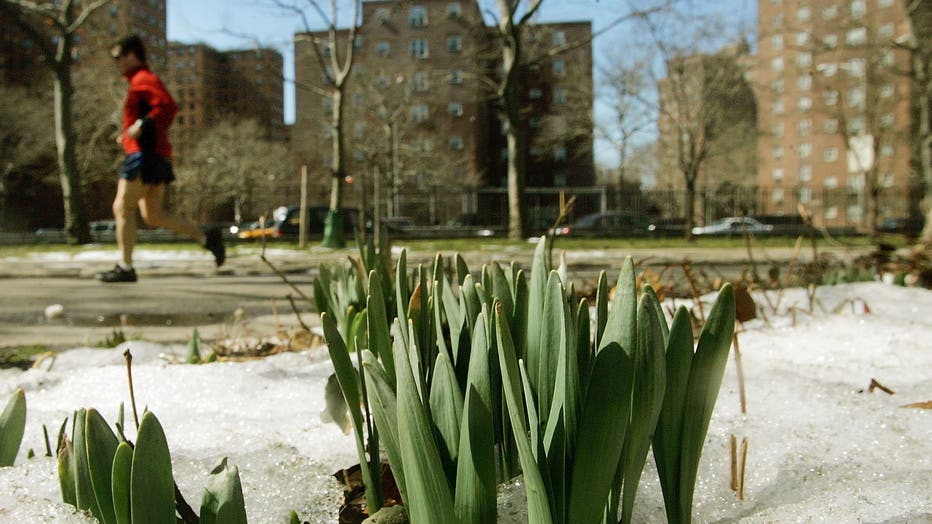
Melting snow in East River Park March 20, 2007 in New York City. (Credit: Mario Tama/Getty Images)
Some cities experienced even more dramatic changes. Burlington, Vermont, recorded the largest increase in average winter temperatures at 7.7 degrees, followed by Milwaukee, Wisconsin, at 7 degrees and Green Bay, Wisconsin, at 6.7 degrees.
Meanwhile, Las Vegas saw the largest increase in warmer-than-normal winter days, with 35 additional days. San Francisco and Fresno, California, each recorded 31 more days.
The other side:
Only two of the 244 cities analyzed experienced cooler average winter temperatures since 1970, with temperatures declining by an average of 0.7 degrees.
In these locations, secondary drivers such as natural climate variability were the leading cause of the observed winter temperature trend.
Climate dominant factor of winter warming
Why you should care:
Climate Central said natural climate variability, the urban heat island effect and other factors influenced the temperature trends.
However, human-caused climate change was the leading driver of winter warming in 97% of the cities analyzed, or 236 locations, according to the report.
In fact, in 112 cities, human-caused climate change accounted for all of the observed winter warming since 1970.
RELATED: Farmers Almanac winter forecast: What a strong El Niño means for your region
According to Climate Central, shorter winters can have consequences beyond seasonal temperatures. Changes can affect snowfall, snow-fed water supplies and winter sports and recreation, along with regional economies that depend on cold-weather tourism.
The effects can also extend into other seasons, influencing spring allergies, summer fruit production and other aspects of the environment.
The findings come as meteorological winter, which includes the months of December, January and February, is set to begin Dec. 1.
The Source: Average temperatures (°F) and days above normal were calculated for each meteorological winter (December, January, February) from 1969-1970 (referred to as "winter 1970") to 2025-2026 ("winter 2026") using data obtained from the Applied Climate Information System (ACIS), which is developed, maintained, and operated by NOAA’s Regional Climate Centers. Data were accessed October 21, 2026. This story was reported from Los Angeles.