

Tech outages across the U.S. What a cybersecurity expert says it could mean
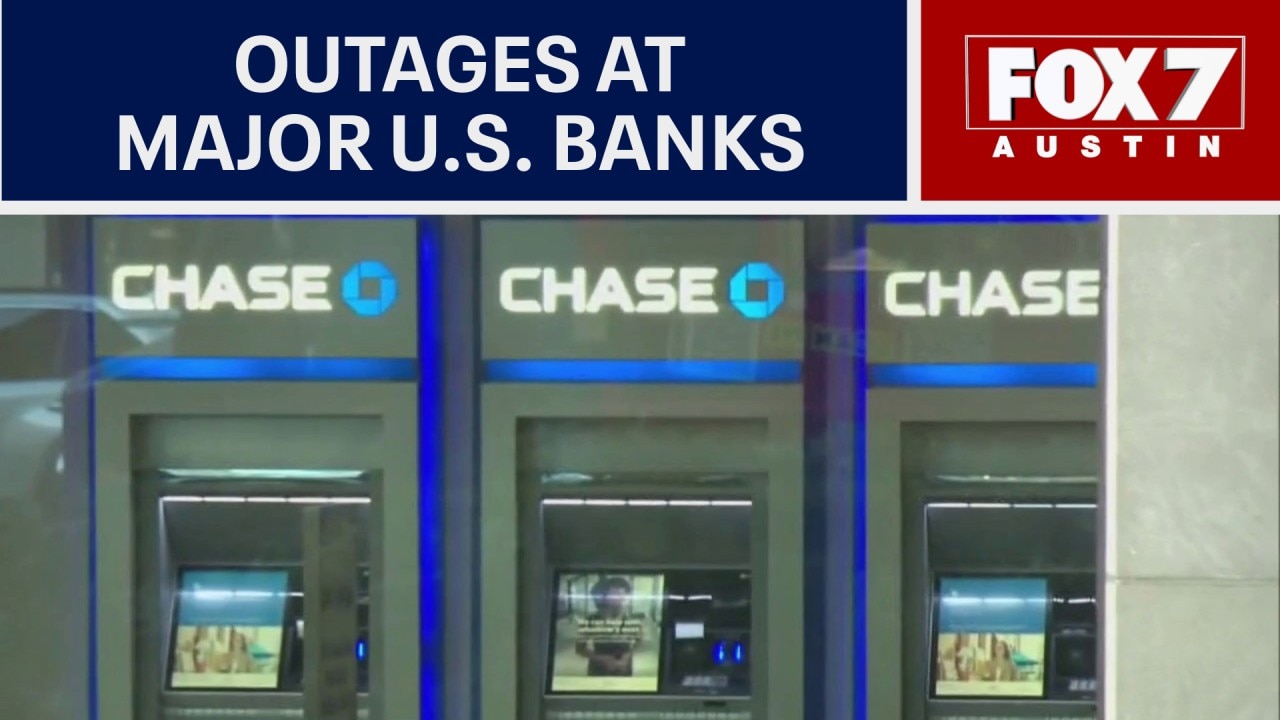
Major U.S. banks experience widespread outage
Technology issues continue across the country, this time with online banking. On Monday, thousands of customers reported issues accessing their accounts. FOX 7 Austin’s Marco Bitonel reports from Downtown Austin.
AUSTIN, Texas - A whirlwind of technological problems continued across the country on Monday.
The backstory:
The latest incident involved major U.S. banks, as thousands of customers reported issues accessing their online accounts. Impacted by the outage were JPMorgan Chase, Bank of America, U.S. Bank, Wells Fargo and Zelle.
At 1 p.m., more than 4,700 Chase Bank members, 2,000 Bank of America users, and 1,000 U.S. Bank and Wells Fargo customers reported issues with their accounts, according to downdetector.
At the center was Chase Bank, which reported that it was experiencing a temporary issue related to a software bug in an on-premise hardware system. One spokesperson said that as a part of the technical issue, some transactions were taking longer to complete.
That delay had an effect on other banking institutions such as Bank of America and Citigroup, who were not having issues with their own services but had certain transactions with Chase slow down.
By Monday evening, Chase Bank had confirmed that the problem was revolved, with a spokesperson telling FOX Local, "We can confirm that transactions are processing normally again."
Big picture view:
Monday marks the latest incident in what has been a turbulent week for U.S. communications and technology. It began on Thursday when a major outage hit Microsoft, impacting services including Outlook, Teams, and AI assistant Copilot.
Microsoft said the disruption involved an "elevated system load" after several servers went offline, overwhelming the remaining infrastructure.
The following day, the nation’s airspace would be brought to a standstill, as the FAA issued a ground stop due to a technical issue. Thousands of flights were cancelled and delayed as apart of the halt. According to the agency, "The FAA’s legacy equipment became unstable when data began flooding the FAA FTI network, at a rate of 1,000 connection attempts every 4 to 5 seconds. This disrupted the system and created instability with aircraft communications and radar feeds."
A radar site in Amarillo, Texas and a radio communications site in El Dorado, Arkansas were listed as the two potential locations responsible for the excessive data flooding the systems. L3 Harris, the FAA’s current network service provider, had been doing work at the El Dorado site, including deployment of a new router.
The FAA, Microsoft, as well as Chase Bank have been quick to state that the incidents are not related to cyber-attacks.
Cybersecurity expert on latest tech outages
What they're saying:
"In a word, no, I have never seen this before," says John Miri, the president of the Electric Grid Cybersecurity Alliance. "If it is purely IT failures, then it is the largest coincidence that I've ever seen in my IT career."
Miri has spent the last 25 years in cybersecurity, in which he says he has protected systems which process billions of dollars of electronic financial transactions for the government as well as safeguarding critical components in the American electric grid.
In his two decades of experience, he says this is the first time that he has seen major U.S. industries experience these sorts of problems just days apart, all while using vastly different systems.
"The infrastructure for Microsoft Outlook, totally separate from the FAA, totally separate from Chase, totally separate from the other banks that have been affected. And yet it's all failing at almost the same time. That's just suspicious," says Miri. "Is it possible that my next-door neighbor won the lottery, jackpot three days in a row? It's possible, just not real likely."
While not ready to fully believe this week’s developments were a cyberattack, Miri says that outside actors need to be considered.
"There's good explanations for things but a pattern that we have seen very frequently, unfortunately, in cyberattacks, is that the attackers wipe their fingerprints and leave behind the evidence that points to a simple mechanical failure," says Miri. "This has happened multiple times. Saudi Arabia in 2017, Ukraine in 2015, Iran in 2010. So, I'm not convinced yet that this is just an amazing coincidence of massive IT failures."
As speculation grows, transparency from officials could be the key to calming fear across the U.S.
"I don't want to freak people out but people are smart and I think the American public knows that there's some risk that this is a cyberattack and they should be worried," says Miri. "Reassure the American people by telling them, we're worried too, and we're doing everything we can to solve this problem."
The Source: Information in this report comes from reporting/interviews by FOX 7 Austin's Marco Bitonel.