

The FIFA rule that allowed Balogun to play despite red card
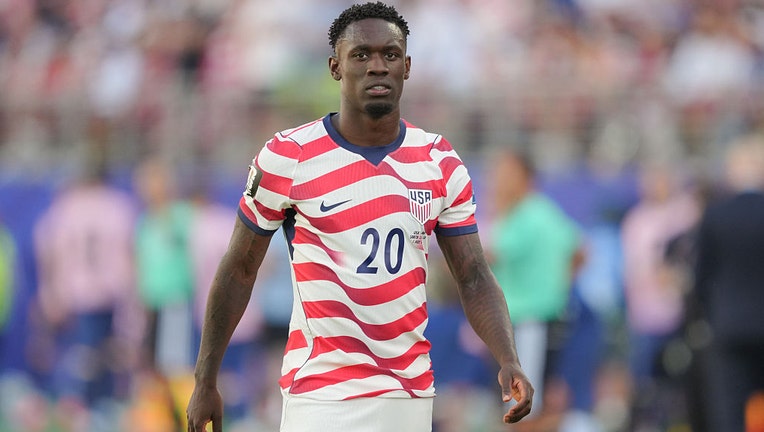
FILE-Folarin Balogun #20 of United States walks off the field after being red carded during the second half against Bosnia And Herzegovina during a FIFA World Cup 2026 Round Of 32 match at San Francisco Bay Area Stadium on July 1, 2026 in Santa Clara
FIFA is allowing United States striker Folarin Balogun to play in the team’s World Cup match against Belgium in the round of 16 match on Monday after soccer’s governing body suspended his ban for a red card in the USA’s last match.
The decision to let Balogun play was referenced under Article 27 of FIFA’s Disciplinary code. This rule gives FIFA discretion to suspend any disciplinary measure.
RELATED: FIFA clears Folarin Balogun to play for USMNT against Belgium
Balogun was sent off the field directly for planting his foot on the ankle of Bosnian defender Tarik Muharemovic during a 2-0 win for the U.S. in the round of 32 against Bosnia-Herzegovina on July 1.
What does FIFA’s rule mean?
Dig deeper:
FIFA’s rule comes from Article 27, titled "Suspension of Implementation of Disciplinary Measures". Here are some key parts of the rule.
- The judicial body may decide to fully or partially suspend the implementation of a disciplinary measure.
- By suspending the implementation of the sanction, the judicial body subjects the person sanctioned to a probationary period of one to four years.
- If the person benefiting from a suspended sanction commits another infringement of a similar nature and gravity during the probationary period, the suspension shall be revoked by the judicial body and the sanction enforced without prejudice to any additional sanction imposed for the new infringement.
- Disciplinary measures relating to match manipulation cannot be suspended.
- According to Article 27, the sanction itself remains in force but does not have to be served immediately unless the suspension is later revoked.
- The article allows FIFA's judicial bodies to suspend the implementation of all or part of a disciplinary sanction.
- However, the code does not mention the circumstances in which a judicial body may decide to suspend a sanction.
- The sanctioned player is then placed on a probationary period of between one and four years.
- If the player commits another infringement of a similar nature during the probationary period, the suspended sanction is automatically reactivated in addition to any new disciplinary sanction.
- Balogun's match ban was suspended for a probationary period of one year.
FIFA rules against Belgium's challenge to Balogun red card
The other side:
On Monday, the FIFA Appeal Committee rendered a request submitted by the Royal Belgian Football Association (RBFA) as "inadmissible" related to the FIFA Disciplinary Committee’s decision to suspend for one year the match suspension imposed on Folarin Balogun, according to a FIFA release.
The Belgian soccer federation earlier Monday challenged FIFA's ruling to let Balogun play despite getting a red card in the previous match, The Associated Press reported.
European soccer body UEFA earlier criticized FIFA for an "incomprehensible and unjustifiable decision," that it said "crossed a red line" by not enforcing Balogun’s mandatory one-game ban.
FIFA’s ruling to defer Balogun's ban for one year of probation was a change from soccer’s traditional rule and led to widespread criticism, including from former World Cup players and coaches at this tournament.
The Source: Information for this story was provided by FIFA, Reuters and The Associated Press. This story was reported from Washington, D.C.